|
The Math Congress Will Not Say Out Loud
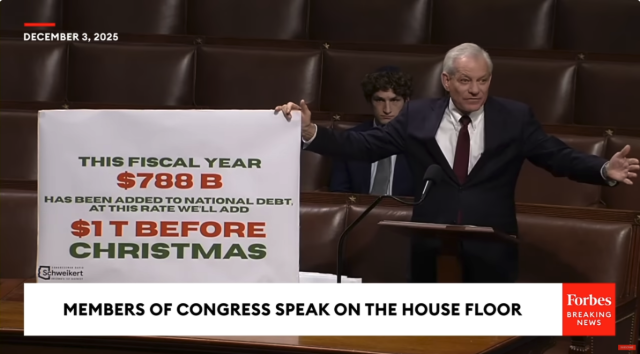
I took to the House floor last week to lay out the basic math Washington refuses to confront. We have doubled the number of 65-year-olds since 2004, yet we have the same number of 18-year-olds. That gap drives most of our debt. In the first 73 days of this fiscal year we borrowed $788 billion. That is about $148,000 every second. At this pace we will cross another trillion dollars of borrowing before Christmas. Social Security and Medicare face trust fund insolvency in 2032. A depletion that will trigger a 24 percent cut in benefits and a surge in senior poverty. Independent economists now warn that our existing pension and health care promises require the next generation to contribute the equivalent of 104 percent of its income. These numbers are real. They are not partisan. I keep making the case for a strategy that raises wages, adopts new technology, and brings down health care costs so the next generation is not crushed by promises Congress refuses to reform.
American Growth Summit

I was honored to join leaders and innovators at the American Growth Summit last week. We focused on how technology and new ideas can help families by lowering the cost of living, raising wages, and creating real economic growth. I believe we can build a stronger future if we stay committed to policies that make life more affordable and expand opportunity for every community.
The Math Washington Refuses to Confront
During my testimony before the House Budget Committee, I laid out the basic math that Washington continues to ignore. We are on track to borrow more than $788 billion in the first 73 days of the fiscal year and we will likely cross the one trillion mark before Christmas. That is about $148,000 a second. I warned the committee that our debt crisis is driven by interest costs and aging demographics. We now have twice as many 65 year olds as we had twenty years ago and the same number of 18 year olds. Both the Social Security and Medicare trust funds are projected to run dry in about seven years, which would mean a 24 percent cut to Social Security checks and an 11 percent cut to Medicare hospital payments. I told the committee that these outcomes are not theory. They are math. I urged my colleagues to focus on policies that grow wages, lower health care costs, and modernize the economy because the next generation deserves more than a future defined by higher taxes and shrinking opportunities.
Getting Ready For Tax Season

The IRS has issued new guidance on Trump accounts, the tax-deferred investment program for children created through the One Big Beautiful Bill. The guidance explains who qualifies, how families can open an account, and how investments must be managed. Children under 18 with a Social Security number may be eligible, and those born between 2025 and 2028 will receive a $1,000 government deposit through the pilot program. A new $6.25 billion corporate pledge from Dell Technologies adds another $250 to each account. Families can contribute up to $5,000 a year and employers can contribute up to $2,500. Funds must be invested in low-fee index funds that track the U.S. market. Money stays in the account until the child turns 18, with an option to roll funds into an ABLE account at age 17. Once the child becomes an adult, the account will transition to standard IRA rules.
What I'm Reading and Why it Matters
ASU grad transforms AI Into meaningful health solutions
An ASU graduate recently featured in the news is putting artificial intelligence to work solving real health problems. Aashritha Machiraju earned a master’s in computer science with a concentration in biomedical informatics. During her time at Arizona State University she helped develop a tremor-reducing glove for individuals with Parkinson’s disease as part of an applied project in community service. She also conducted advanced research in the Embedded Machine Intelligence Lab at ASU, focusing on “multimodal” AI for health applications. That means she worked on systems that combine different types of data — such as motion, physiology, maybe neural signals — to help make health tech more adaptive and human-centered.
|