|
How fast Washington Is Really Borrowing Money
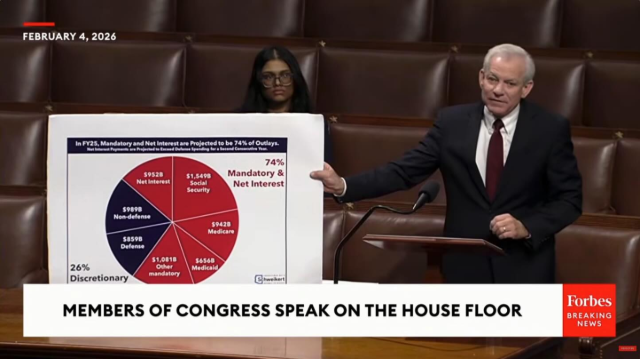 When we are in session, almost every week I end up on the House floor trying to walk through the same uncomfortable reality. The country is taking in more money and still managing to drown itself in red ink. Over the last twelve months, federal tax collections are up close to ten percent. That should be the part of the story that feels hopeful. Yet in that same twelve-month window, Washington still borrowed about $2.34 trillion. Run the tape and that works out to roughly $74,000 a second. You don’t have to like that number, but you at least have to look at it. When we are in session, almost every week I end up on the House floor trying to walk through the same uncomfortable reality. The country is taking in more money and still managing to drown itself in red ink. Over the last twelve months, federal tax collections are up close to ten percent. That should be the part of the story that feels hopeful. Yet in that same twelve-month window, Washington still borrowed about $2.34 trillion. Run the tape and that works out to roughly $74,000 a second. You don’t have to like that number, but you at least have to look at it.
The mechanics are not complicated. We have about ten to eleven trillion dollars of existing debt that has to be rolled over in this twelve-month period. Much of it was issued when interest rates were very low. Now it comes due and has to be refinanced at today’s rates. No speeches, no press releases, just a very large bill that shows up whether you are ready or not. At the same time, federal health care spending is coming in hotter than the official projections. We were told to expect about five percent growth. Some of the real-world numbers are closer to eight or nine. When you start from a base that is already over a trillion dollars for Medicare, that difference is massive.
If you put a picture of the federal budget up on a board, only about a quarter of what we spend each year is the “discretionary” slice that Congress actually votes on, including defense. That share is drifting from around twenty-six percent down toward twenty-five. Every dollar in that quarter is financed. The rest is on autopilot. Interest on the debt, Social Security, Medicare, Medicaid, and the other mandatory programs roll forward under formulas that were written years ago. Add up the discretionary side and you are under two trillion dollars. Now remember we just borrowed over $2.3 trillion in twelve months. That means every dime of the part Congress fights over is effectively borrowed, and a piece of the autopilot side is borrowed as well. That is what I mean when I say your federal government behaves like an insurance company with an army attached to it.
If you want to see this in real time instead of trusting talking points, my Joint Economic Committee team sends out a Daily Debt text. It simply does the math each workday. Over the last twelve months, the government has been borrowing about $74,400 a second. If you only look at the first four months of the current fiscal year, it is closer to $85,000 a second. You do not have to memorize the charts, but you should at least understand the order of magnitude before someone tells you we can fix this with a slogan and a magic offset.
Underneath all of it is the demographic reality no one in this town wants to campaign on. In less than three years, more than half of all federal spending will go to Americans who are 65 and older. We have had thirty or forty years of falling birth rates. We are now basically flat on population growth. That means more retirees, fewer workers, and very expensive health care. Under current law, the Social Security trust fund runs dry in about six and a half years. If Congress keeps pretending nothing is wrong, that triggers a roughly twenty-four percent cut in benefits. The models in my office say that would double senior poverty. The Medicare trust fund empties on almost the same timeline and hospitals take about an eleven percent cut on those payments.
One of the papers we keep on the conference table in my office, from a group of very bright economists back east, runs the long-term math using a six percent generational discount rate. Their conclusion is that a baby born today would owe the equivalent of one hundred and four percent of his or her lifetime income just to cover federal pensions and promises. That is federal, not state. You do not have to be an economist to recognize that as a moral problem. The political class has spent years telling voters what they want to hear. My job is to keep dragging the calculator back into the conversation and remind everyone that if we want Social Security and Medicare to exist for our kids and grandkids, we have to start with the numbers as they are, not as we wish they were.
Watching FFA's China problem
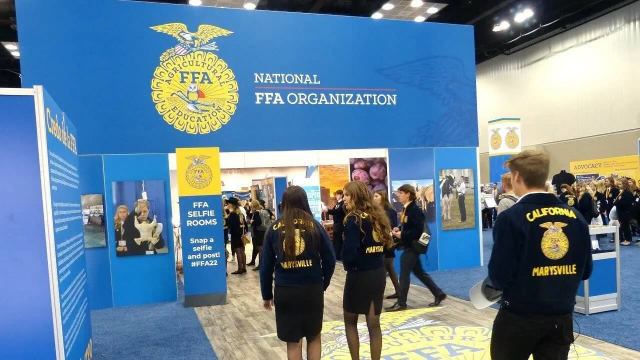 This month, I joined Chairman Jason Smith and Rep. Tracey Mann in demanding answers from the National FFA Organization about its partnership with the Syngenta Group and its decision to lean into DEI programming instead of staying focused on agricultural education. FFA is not a small operation. It is a federally chartered, tax-exempt group based in Indianapolis that touches over one million student members in more than 9,000 chapters across the country. When you are shaping the next generation of American farmers, you do not get to be casual about who you let inside the tent. This month, I joined Chairman Jason Smith and Rep. Tracey Mann in demanding answers from the National FFA Organization about its partnership with the Syngenta Group and its decision to lean into DEI programming instead of staying focused on agricultural education. FFA is not a small operation. It is a federally chartered, tax-exempt group based in Indianapolis that touches over one million student members in more than 9,000 chapters across the country. When you are shaping the next generation of American farmers, you do not get to be casual about who you let inside the tent.
Syngenta is not just another agribusiness sponsor. It is owned by a China-backed parent and has been treated by our own government as part of the broader Chinese state industrial machine. When a company with that background is helping drive FFA policy and sitting at the table on DEI and “strategic direction,” it stops being a simple sponsorship and starts looking like foreign influence over the pipeline that feeds our farm and food system. That is exactly the kind of thing the Ways and Means Committee is supposed to police in the tax-exempt world.
In our letter, Chairman Smith, Rep. Mann, and I made it clear: if you want the benefits of a U.S. tax exemption, you follow U.S. law and you keep your mission front and center. FFA’s stated purpose is “leadership, personal growth, and career success through agricultural education.” That is a serious responsibility. It is not an excuse to import ideological fads, hand a foothold to a company tied to a foreign adversary, and hope no one notices.
We also reminded FFA of something USDA has already put in writing: farm security is national security. You cannot say you are preparing future farmers to safeguard America’s food supply and then downplay the risk of letting a CCP-linked firm help steer the organization. So we have directed FFA to turn over contracts, financial arrangements, and internal documents that spell out Syngenta’s role, including its involvement in setting DEI policy, by February 17.
If the facts show FFA is staying in its lane and protecting its kids, they should have no problem producing the records. If the facts show otherwise, then Congress, and the taxpayers who fund these benefits, deserve to know that too.
Sitting down with Navajo Housing Authority Leadership
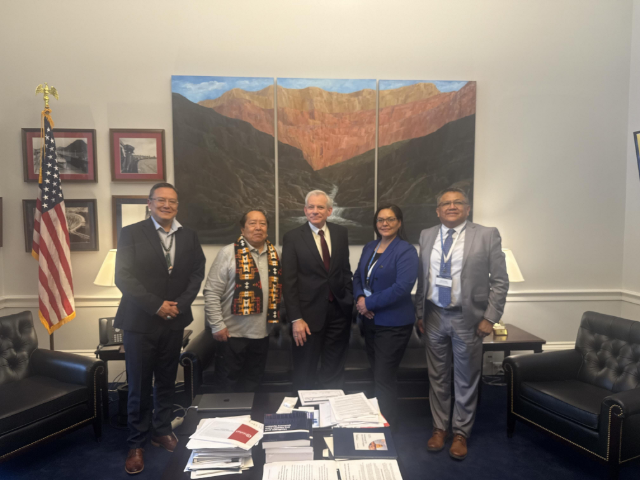 Last week I met in my D.C. office with leaders from the Navajo Housing Authority: Board Chair Marcus Denetdale, Secretary/Treasurer Tammy Yazzie, Chief Financial Officer Raymond Nopah, Chief Administrative Officer Terrilyn Cook, and Interim CEO Levon Henry. We spent our time walking through the real-world bottlenecks that slow housing projects on the Navajo Nation. Last week I met in my D.C. office with leaders from the Navajo Housing Authority: Board Chair Marcus Denetdale, Secretary/Treasurer Tammy Yazzie, Chief Financial Officer Raymond Nopah, Chief Administrative Officer Terrilyn Cook, and Interim CEO Levon Henry. We spent our time walking through the real-world bottlenecks that slow housing projects on the Navajo Nation.
NHA is the largest Indian housing authority in the country and roughly the eighth-largest public housing authority overall, managing about 8,500 housing units directly and another 2,000 units through sub-recipients across the Nation. When you operate at that scale, a small change in a federal rule, a funding formula, or a permitting timeline doesn’t live on paper. It shows up as families waiting years longer than they should for a safe home, electricity, or running water.
My focus in these conversations is always the same: get past the talking points and into the mechanics. How long does it actually take HUD or other agencies to sign off on a project? Where do plans sit on a desk for months? Which requirements add cost without adding safety? My team and I are going to keep working with NHA leadership to push for faster approvals, more predictable funding, and a federal process that respects tribal self-governance instead of burying it in red tape.
Free tax help you may qualify for

Tax season is stressful enough without also paying someone a big fee just to file the forms. If your income is more modest, there are free options that are actually pretty solid.
The Internal Revenue Service helps fund two programs that offer free basic tax return preparation from trained volunteers: Volunteer Income Tax Assistance (VITA) and Tax Counseling for the Elderly (TCE). These are community sites run by local partners, not paid storefronts, and every return is prepared and reviewed under IRS standards.
You may qualify for VITA if:
You generally make $69,000 or less
You are a person with disabilities
You are a limited English speaker who needs help with your return
TCE is geared toward taxpayers 60 and older and can help with pensions, Social Security, and other retirement questions that easily trip people up. A lot of the volunteers are retired professionals who decide to spend part of tax season helping neighbors get their returns right.
Sites are usually in familiar places like community centers, libraries, schools, and churches. To find one near you, you can:
Use the IRS VITA Locator Tool online or call 800-906-9887
For senior-focused TCE sites run by the AARP Foundation Tax-Aide program, visit their locator or call 888-227-7669
If you go, bring: a photo ID, Social Security cards or ITIN letters for everyone on the return, last year’s return if you have it, and all W-2s, 1099s, and other income or tax forms you received. A complete folder makes it much easier for the volunteer to get the math right the first time.
If you qualify, this is a way to keep more of your refund instead of spending it on preparation fees, and still have a return that meets IRS standards.
What I'm Reading and Why it Matters
Arizona State University students pitch AI tools to improve campus life
Arizona State University has launched an AI Acceleration Student Innovation Challenge that lets students help decide how AI shows up on campus instead of just having tools handed down from above. Sixteen students are spending three weeks in small teams building and refining ideas like smarter study support, proactive mental-health tools, help for student entrepreneurs, and a centralized hub for events and services. At the end, four teams will present their prototypes to CIO Lev Gonick and the AI Acceleration leadership group, and at least one project is expected to feed directly into ASU’s future AI work. |