|
The Trust Fund Crisis Nobody in Congress Wants to Discuss
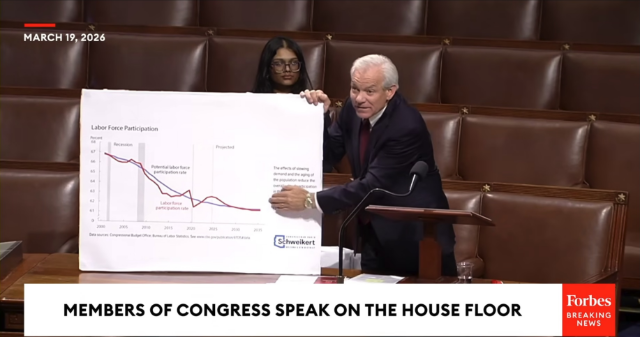
For every dollar in tax receipts last year, we spent $1.43. We crossed $39 trillion in debt. We are borrowing $87,400 a second.
I come behind that microphone almost every week because Congress functionally does not own a calculator. Only 25% of spending is even voted on by members. The rest runs automatically and nobody wants to touch it.
Here is the part that should genuinely alarm you. In six and a half years the Social Security trust fund is empty and the Medicare trust fund is empty. That is not a projection I invented. That is CBO. Under current law that means a 24% cut to Social Security checks and about an 11-12% cut to hospital Medicare reimbursements. To cover just the first year of that shortfall out of the general fund costs $638 billion. The entire defense budget is roughly $1 trillion.
I also made the case for moving to a talent-based immigration system. Not the border conversation, a different one. A 30-year-old with a STEM graduate degree generates about $2.5 million in taxes over 30 years. Someone without a high school diploma costs society roughly $100,000 over that same period. Canada, New Zealand, and Great Britain already built their immigration systems around exactly that math. We are the last industrialized country still running a family sponsorship model.
We have known these trust fund numbers for years. At some point not talking about it becomes its own choice.
My Joint Economic Committee Hearing on Immigration and the Workforce
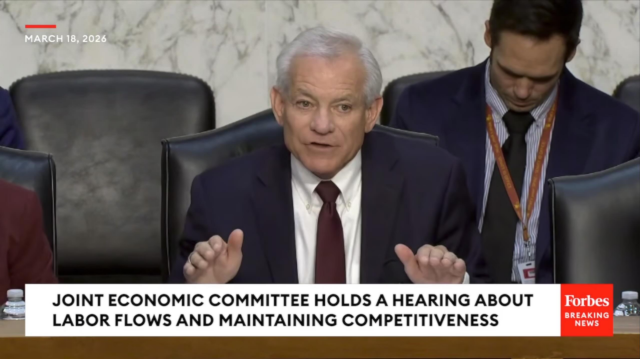
Last Wednesday, I chaired a Joint Economic Committee hearing with four economists on one of the more politically uncomfortable parts of fixing our debt problem, which is demographics.
We have the same number of 18-year-olds today as we had 20 years ago and double the number of people 65 and up. Social Security and Medicare trust funds are empty in six and a half years. The math on keeping those promises requires workers paying into the system and we do not have enough of them.
I pressed the witnesses on whether the H-1B's employer-sponsored structure suppresses wages because workers cannot move freely through the economy, and whether a portable points-based system like Canada or Australia runs would produce better outcomes. The witnesses broadly agreed portability helps and that replacing the lottery with a wage-ranking system that prioritizes younger high-skilled workers makes more economic sense. There was also a real conversation about the temporary-to-permanent distortion where the permanent residency backlog is so long that it warps how employers use the program entirely. High-skilled immigrants are net fiscal contributors who boost productivity and drive long-term wage growth. Lower-skilled immigration is where the federal fiscal math gets seriously difficult.
President Trump has said it himself repeatedly. It is insane that we educate people and send them home to compete with us. A 30-year-old with a graduate degree in engineering generates roughly $2.5 million in taxes over 30 years and right now we hand them a diploma and put them on a plane home.
My Letter to President Trump on California Refinery Closures and Arizona Gas Prices
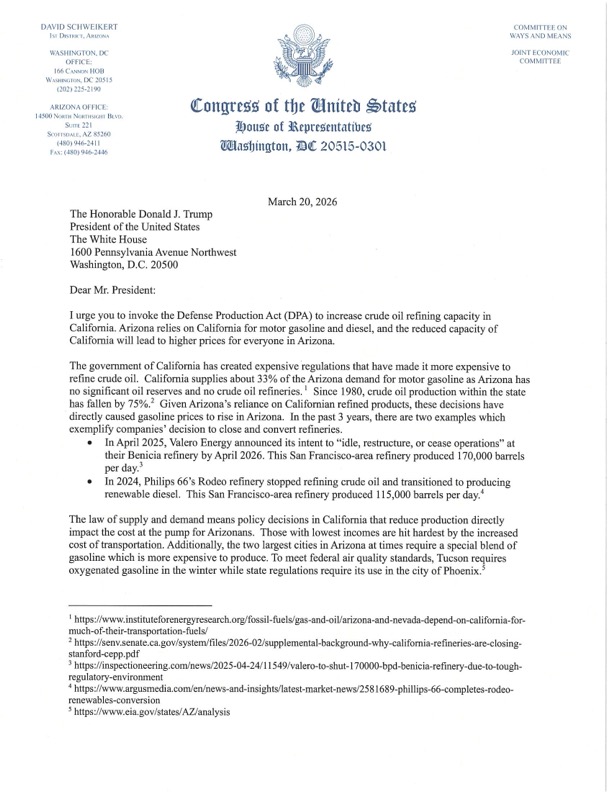
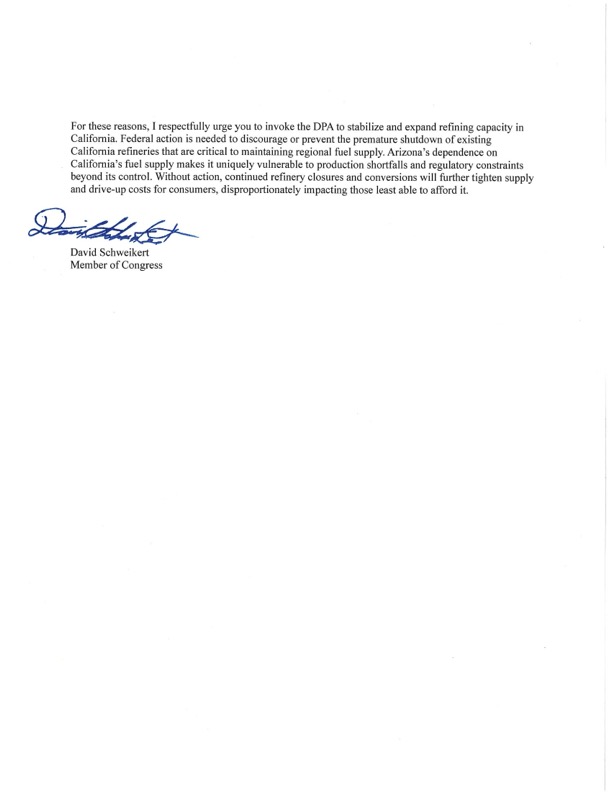
On Friday, I sent a letter to President Trump urging him to invoke the Defense Production Act to increase crude oil refining capacity in California. This directly affects what Arizonans pay at the pump.
Arizona has no significant oil reserves and no crude oil refineries. We rely on California for roughly 33% of our motor gasoline and diesel supply. Since 1980, crude oil production in California has fallen by 75% and California regulations have made refining increasingly expensive. That cost gets passed directly to Arizona consumers.
Two recent decisions make this urgent. In April 2025, Valero Energy announced plans to idle its Benicia refinery by April 2026, which produced 170,000 barrels per day. In 2024, Phillips 66's Rodeo refinery stopped refining crude oil entirely and converted to renewable diesel production at 115,000 barrels per day. That is a significant loss of regional refining capacity.
Phoenix and Tucson already require a special oxygenated gasoline blend that costs more to produce. Tighter supply from California refinery closures hits Arizona consumers harder than most states and hits lower-income families hardest of all.
I urged the President to use the DPA to stabilize existing California refining capacity before more closures make the problem worse.
Introducing the Taxpayer Experience Improvement Act
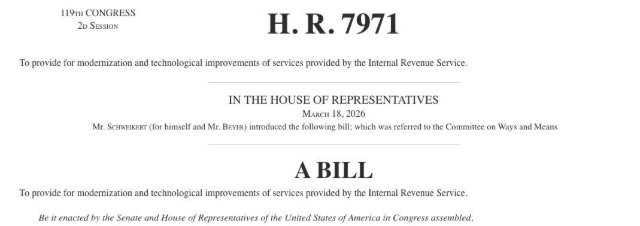
On Wednesday, I introduced H.R. 7971, the Taxpayer Experience Improvement Act, along with Rep. Don Beyer. This is a straightforward bill that does something the IRS has needed for a long time. Give taxpayers basic real-time information about what is happening with their return and how long they are going to be waiting on hold.
The bill requires the IRS to publish a live dashboard showing call wait times and backlog status. It requires the agency to give taxpayers specific up-to-date information through a website or mobile app about where their return is in processing and when their refund is actually coming. It also expands callback technology so anyone waiting more than five minutes on hold gets the option to receive a callback instead.
If you have ever spent an hour on hold with the IRS trying to get a straight answer about your refund you understand why this bill matters. These are basic transparency and customer service standards that taxpayers have every right to expect.
Upcoming Joint Economic Committee Hearing: Foreign Scam Networks Targeting Americans
The Joint Economic Committee is holding a hearing on the threat posed by overseas scam compounds, federal coordination to fight fraud, and the economic impacts on Americans.
We are bringing in officials from the Department of Justice, FBI, FTC and the U.S.-China Economic and Security Review Commission alongside experts from the GAO, the Aspen Institute and AARP. This is the first hearing this session of Congress to include current administration officials on this topic.
The hearing will examine how AI is enabling more sophisticated fraud operations, how overseas scam compounds are scaling up their activity, and whether our current federal tools are keeping pace. Criminal syndicates are targeting American seniors and in many cases wiping out retirement savings entirely. The money leaving our economy through these operations is financing criminal networks abroad.
Ranking Member Senator Maggie Hassan and I have been working on this issue together and previously sent requests to federal agencies about their efforts to crack down on overseas scam networks.
You can watch the hearing live Wednesday at 1:30 PM ET here.
|