|
Stopping the Scam Before the Money Leaves
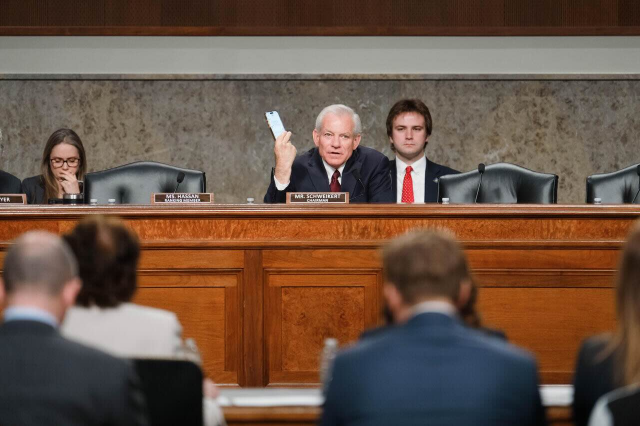
Last week, I chaired a Joint Economic Committee hearing on the rising global scam economy. One of the things I kept pressing on was how backwards our current model has become. Too often, an American gets hit first, the money is already gone, and only then do the institutions involved begin asking whether something can be recovered. That is not a serious way to protect people. If the money has already left the account, the system has already failed.
The testimony was useful because it forced everyone to admit the same basic truth. Education matters, but it is not enough anymore. These scams are too sophisticated and too manipulative to pretend a warning brochure solves the problem. They are using better technology. They are moving faster. They are getting inside a victim’s head before anyone around that person has a chance to intervene.
That is why I kept pushing the hearing toward prevention. The communication itself should be identified before the fraudster reaches the victim. The payment should be stopped before the transfer clears. That means the companies carrying the communication and the institutions moving the money have to do more than they are doing now. Telecom firms, technology platforms, banks, payment companies, and others all have a role here. Law enforcement matters, but by the time law enforcement arrives, the damage is often already done.
A number of the witnesses made that point in different ways. Education still has a place. Better awareness still helps. But the real change has to come from better tools, earlier detection, and much stronger coordination across the private sector. We discussed caller ID authentication, scam call labeling, voice-clone detection, spoofing detection, and better cooperation with financial institutions, especially where cryptocurrency is involved. Those are the kinds of things that move this from reaction to prevention.
This is not some small nuisance issue. It is a growing criminal industry that is taking real money from real people, especially seniors. It is also feeding foreign criminal networks that have figured out our defenses are too fragmented and too slow. Our tools have not kept pace. They need to. The standard should be simple: stop the scam before the money leaves.
The Swamp is Buying the Noise
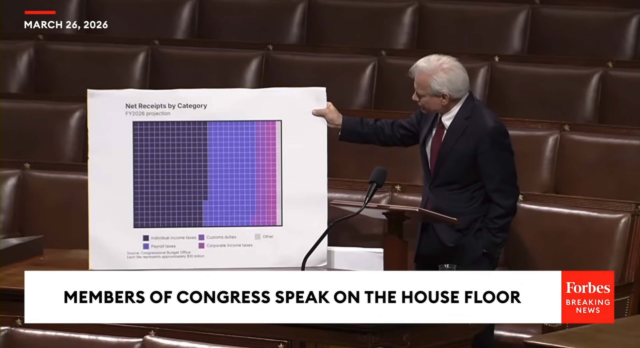
On the House floor last week, I spent my time on something Washington would much rather not discuss in public. The swamp is no longer just the crowd walking the hallways asking for favors. It is now sitting in the information pipeline. Lobbyists are paying to shape what people read and hear whenever Congress gets too close to reform. In the speech, I walked through conservative publications getting cash to run what some lobbyist wanted pushed. I talked about influencers being paid to blur what Medicare Advantage actually is while some of us are trying to clean up the math. I even raised the example of large food interests paying social media voices to shut down discussion around GLP-1 drugs. Once you see it, a lot of the nonsense around this place starts making more sense. The racket does not just buy policy. It buys cover.
While all of that theater is going on, the country’s balance sheet keeps getting worse. Congress only votes on about a quarter of federal spending. The rest runs on autopilot. Treasury’s own statement shows roughly $47.8 trillion in current liabilities against about $6 trillion in assets. If you isolate the long-term Social Security and Medicare obligations, the hole is about $88.4 trillion. We are borrowing around $88,000 a second. Six months into the fiscal year, borrowing was running at more than 7.3 percent of the entire economy. Just interest has grown so large that it now sits above categories Washington used to treat as untouchable. Yet the political class still behaves as if the real danger is someone bringing a calculator into the room and ruining the mood.
That was the point of the speech. I was not there to add another shiny object to the pile. I was there to say, again, that this country is drifting into a place where the bond market will end up imposing discipline because elected officials refuse to do it themselves. I have been hearing for fifteen years that we can tell the truth after the next election. There is always another election. In the meantime the debt compounds, the interest bill grows, and the same people who lecture everyone else about responsibility keep handing our children obligations they have no intention of explaining honestly.
None of this means the problem is beyond fixing. It means the country needs a little more seriousness and a lot less performance. I said on the floor what I have been saying for years: there are ways to drive down health care costs, ways to attack waste and fraud, ways to make the economy more productive, and ways to stabilize the debt if people are willing to do the work. What we do not have enough of in Washington is a tolerance for reality. The math always wins. The only choice left is whether we deal with it ourselves or wait until the country gets dealt with by it.
Service Academies Conference 2026
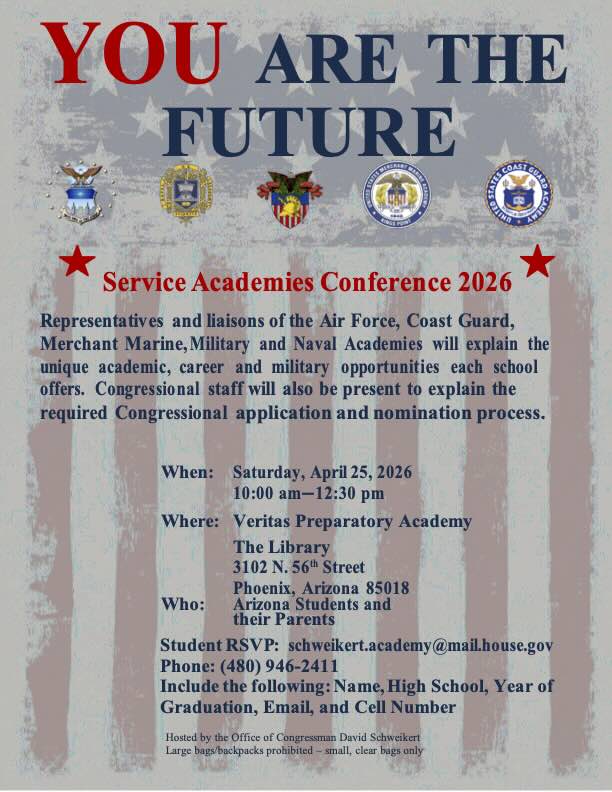
Each year, I have the privilege of nominating a limited number of students for scholarships to attend a military service academy. The U.S. Service Academies are among the most highly respected educational programs in the nation. To be admitted to an academy, applicants must meet stringent academic, physical and medical requirements specified by public law. As a cadet/midshipman at the academy, students will be provided a fully funded four-year college education. The honor of attending an academy comes with an obligation and commitment to serve for a minimum of five years upon graduation.
High school students interested in meeting with service academy liaisons and learning more about the 2026 academy application process, for Arizona’s First Congressional District, are encouraged to attend the academy liaison forum on April 25th at Veritas Preparatory Academy. Student’s RSVP and Registration here
For additional questions regarding the application process please refer to our academy resource guide and FAQ link below, or contact Chelsea Lett, Service Academy Coordinator, in my District Office at (480) 946-2411.
Making the IRS Behave Like It Is 2026
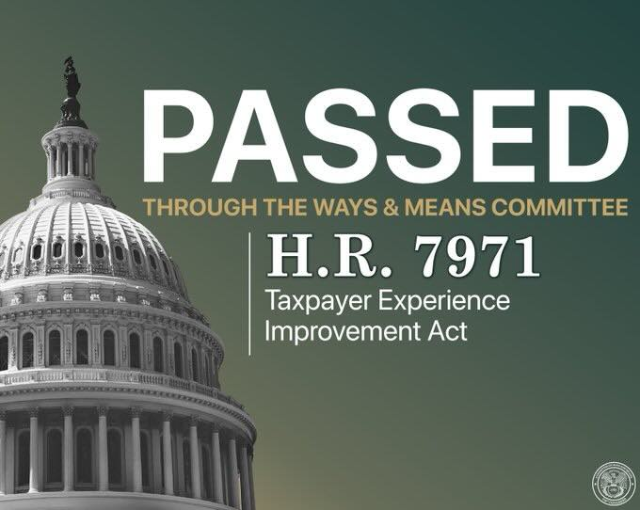
Last week, the Ways and Means Committee moved my bill, the Taxpayer Experience Improvement Act, out of committee. I introduced it with Rep. Don Beyer for a simple reason. If the IRS is going to take your money, it ought to be able to tell you where your refund is.
The problem is the whole taxpayer experience. Too many people still have to dig, call, wait, and guess just to get basic information from an agency that already has it. If you are waiting on a refund, you should be able to see where it sits in the process. If you need an answer, you should be able to get one without wasting half your day.
During the markup, I pointed to the numbers. Roughly 23 percent of IRS software is 25 to 64 years old. About a third of the agency’s IT applications are decades old. That helps explain why dealing with the IRS still feels like dealing with a government that got comfortable being slow.
The tools to do this better already exist. The public uses them every day in the private sector. My bill pushes the IRS to catch up and start treating taxpayers like people who deserve visibility into their own returns instead of obstacles in a broken system.
What I'm Reading and Why it Matters
AI cameras help detect wildfires in Arizona amid early start to season
Arizona is already running four to six weeks ahead of normal on vegetation curing, which tells you how serious this fire season could get. The encouraging part is that the state is finally using technology the way it should. AI cameras in remote areas and a stronger dispatch center mean earlier detection, faster response, and better decisions about where to send aircraft, engines, and crews. In a state this dry and this spread out, minutes matter. This is the kind of modernization government ought to be doing.
|