|
Dear Community Member,
After another all-night session, the U.S. House of Representatives voted 218-214 on President Donald Trump’s sweeping tax package, passed through the budget reconciliation process. At some 887 pages, the purely partisan legislation is a sprawling collection of tax breaks, spending cuts, and other Republican priorities, including new money for national defense and deportations. I voted against this legislation because Speaker of the House Mike Johnson refused to negotiate with Democrats and back off the bill’s long-term negative impact on working families, our healthcare system, nutrition programs, environmental incentives, and our nation's fiscal future.
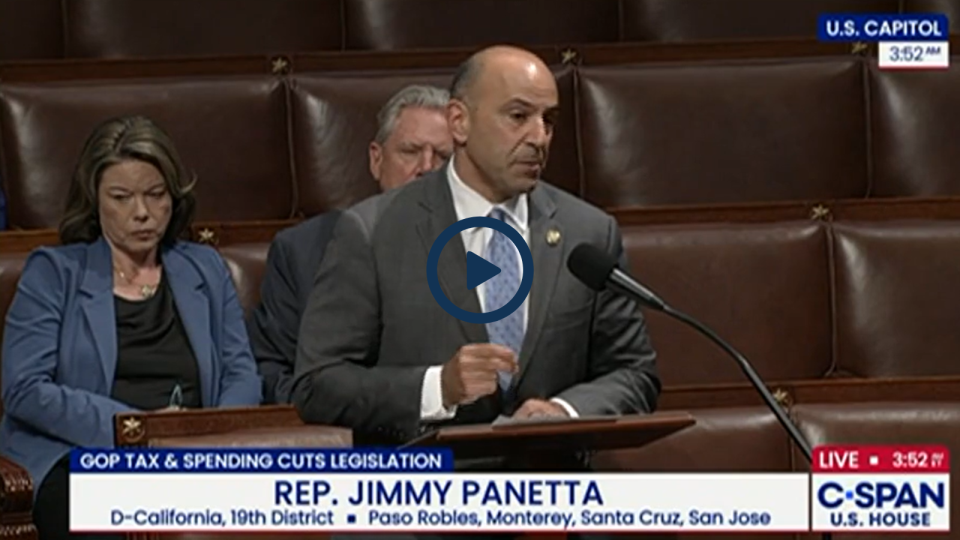 |
Rep. Panetta at 4:00 AM debating the partisan reconciliation bill
before its final passage.
Press play or click HERE to watch remarks by Rep. Panetta. |
The reconciliation process allows Congress to pass certain budget-related legislation with a simple majority in the Senate. It is intended to help lawmakers act quickly on fiscal policy. Unfortunately, and due to an arbitrary date dictated by the President, this partisan bill was rushed through both the House and the Senate with limited public input and absolutely no bipartisan engagement.
The bill contains about $4.5 trillion in tax cuts that would cost $3.4 trillion over ten years, according to the nonpartisan Congressional Budget Office (CBO). Many of the bill’s provisions are temporary, but if extended, as many expect, the legislation could cost as much as $5 trillion. At its core, the bill locks in and expands tax cuts from 2017 that disproportionately benefit the wealthiest individuals and large corporations. These benefits are not broadly distributed. While the top 0.1% of earners will see an average tax break of over $300,000, families making under $50,000 per year will receive just 68 cents a day in relief. The bill also would temporarily add new tax deductions meant to meet the President’s campaign promises including no taxes on tips, overtime pay, automotive loans, and social security. However, the deductions to offset taxes on tips and overtime are capped at $25,000 and do not exclude workers from paying Federal Insurance Contributions Act taxes. The deduction for seniors is $6,000 for those making $75,000 a year or less. The bill would make permanent the $2,000 child tax credit and retain rules that mean millions of families at lower income levels would not get the full credit. A cap on state and local deductions, called SALT, would quadruple to $40,000 for five years. There are business-related tax cuts, including allowing businesses to immediately write off 100% of the cost of equipment and research.
The bill imposes policy changes that could lead to severe reductions in Medicaid and the Affordable Care Act. According to the CBO, 12 million Americans stand to lose healthcare coverage under the legislation. In California’s 19th Congressional District, more than 12,000 constituents could become uninsured, and hospitals across the state would see more than $9 billion in increased uncompensated care costs. The legislation makes it difficult to qualify for Medicaid by requiring additional paperwork and frequent income verification, which disproportionately affects low-income families, seasonal workers, and people with disabilities. New co-pays and reduced retroactive coverage will also make healthcare harder to afford for those who remain eligible. Meanwhile, the bill phases in a cap on provider taxes that would significantly reduce California’s ability to fund Medi-Cal, potentially leading to cuts in services and reimbursement rates. These provisions are not just policy shifts, they can lead to real reductions in healthcare and support for some of the most vulnerable people in our communities.
The bill cuts food assistance. The bill reduces funding for the Supplemental Nutrition Program (SNAP) by $200 billion. It makes it harder for older adults, parents, and low-income families to qualify and receive benefits. States will now shoulder more of the cost for both SNAP benefits and administrative responsibilities, all while federal oversight grows stricter. These changes risk increasing food insecurity at a time when the cost of groceries and basic necessities remains high for families across our congressional district.
The bill would dramatically roll back tax breaks designed to boost clean energy projects fueled by renewable sources such as solar and wind. The tax cuts were a central component of our 2022 landmark Inflation Reduction Act that focused on addressing climate change and put us on course for a 40% reduction in our carbon output. However, this bill would reduce that progress by 10% and raise the cost of renewables by 10-20%. A tax break for people who buy new or used electric vehicles would expire on Sept. 30 of this year, instead of at the end of 2032 under current law.
.png "Rep._Panetta_on_KSBW_Tax_Bill_(1).png") |
Rep. Panetta continues his advocacy against the reconciliation bill.
Press play or click HERE to watch Rep. Panetta’s interview with KSBW. |
The bill also severely limits access to care for immigrant families. It expands existing exclusions from Medicaid and ACA coverage, effectively cutting out groups currently in legal status, including asylum seekers and other lawfully present individuals. Moreover, the bill creates a tax on any remittances sent to their home countries by immigrants who are working in the United States.
The bill would provide some $300 billion to bolster the President’s deportation and national security policies, as he aims to fulfill his promise of the largest mass deportation operation in U.S. history. There are no explicit appropriations for the golden dome, the President’s plan for a national missile defense system, the bill includes over $8 billion for air and missile defense enhancements that could be used to advance the project. The bill also contains $6 billion for infrastructure and quality of life improvements for service members, along with funding to enhance the U.S. presence in the Indo-Pacific, bolster AI and Cyber tools and support the U.S. industrial base.
The bill provides millions for the President’s special projects, including $40 million to establish Trump’s long-sought “National Garden of American Heroes.” There’s a new excise tax on university endowments. A $200 tax on gun silencers and short-barreled rifles and shotguns was eliminated. One provision bars money to family planning providers, namely Planned Parenthood, while $88 million is earmarked for a pandemic response accountability committee. Billions would go for the Artemis moon mission and for the exploration of Mars.
The bill enormously increases our national debt by adding nearly $4.1 trillion over the next decade. The CBO expects America to run an average annual fiscal deficit of 5.8% of GDP over the coming decade. However, the bill would increase that by a further 1.25% and we would end up with a public debt of more than 120% of GDP. The increased debt is especially dangerous as interest rates remain high, making each dollar of borrowing more expensive. A growing debt then will put pressure on interest rates that would not only make our debt more expensive to finance, it would make borrowing money more expensive and lead to a drag on private investment. Supporters argue that economic growth will offset the cost, but nonpartisan experts caution that these projections are overly optimistic. If those assumptions don’t materialize, rising interest payments, projected to exceed $40 trillion over the next 30 years, could crowd out federal investments in areas like education, emergency preparedness, and infrastructure and slow our nation’s economic growth.
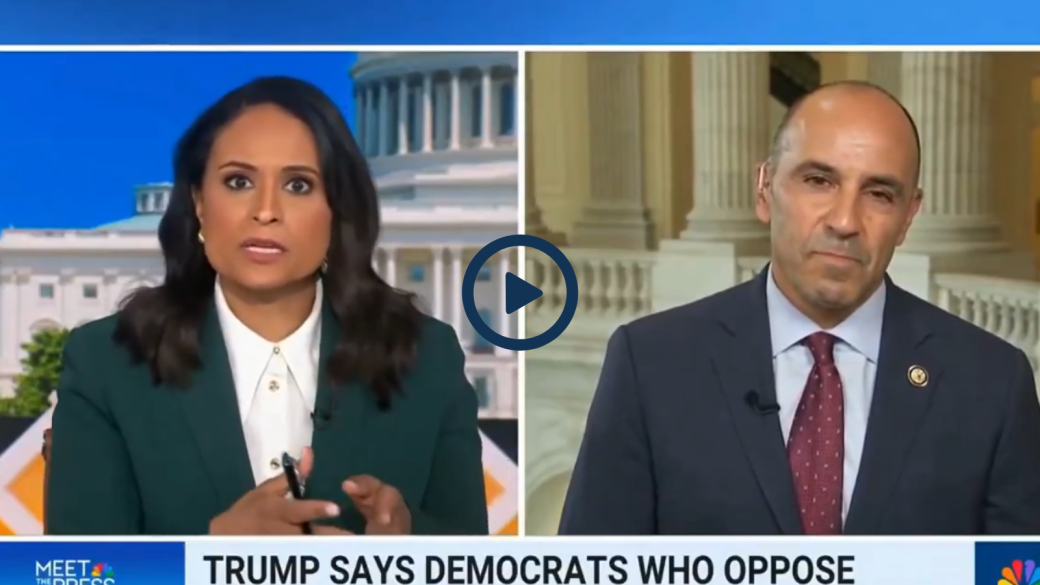 |
Rep. Panetta continues to be a leading voice against the reconciliation bill.
Press play or click HERE to watch Rep. Panetta’s interview with NBC. |
My colleagues and I offered amendments to fix the most harmful aspects of the President’s tax package and refocus it on the needs of working families. I was proud to author and resubmit my amendment which aimed to strike the $5 trillion increase to the debt ceiling contained in the bill. This provision from the Majority effectively greenlights over $5 trillion in new borrowing, primarily to fund permanent tax breaks for the wealthiest Americans, while cutting support for healthcare, food programs, and student loan relief. My amendment was straightforward, but not accepted. If we are going to have a serious conversation about fiscal responsibility, we cannot ignore the impact that this added debt will have on our economy, our communities, and future generations. Although the amendment did not pass, I felt it was critical to raise these concerns and highlight the tradeoffs.
The bill does adopt several pieces of legislation that I authored, even though I am disappointed with the overall damaging policies of this bill. My bills could have been advanced on a bipartisan basis had the majority chosen to bring Democrats to the table to create a better product. Specifically, the bill includes my Fair Access to Agriculture Disaster Programs Act which helps farmers in high-cost areas like the central coast of California by increasing the income limitations on certain farm assistance programs. It also includes my bill to extend Qualified Duty Hazardous Pay to service in Mali, Burkina Faso, Kenya, and Chad. Additionally, the bill includes several pieces of legislation that I co-lead, including legislation to support specialty crop producers, increase funding for agricultural market development programs, support the development of affordable housing, and support research and development in the private sector.
Throughout the process, I’ve worked hard to inform constituents about the impact of this bill through my numerous townhalls, meetings, newsletters, and emails. I’ve been consistent in my messaging and principled in my votes against this legislation. Although I am against this legislation, I continue to press for policies that help restore my constituents’ faith in the American Dream. But for that to happen, the federal government must live up to its part of the bargain by providing the opportunities for people to succeed. That includes polices to incentivize affordable housing, provide accessible healthcare, support our schools, fix our broken immigration system, protect our environment, encourage trade deals, bolster public safety, and strengthen our national and fiscal security. We need tax reform, but it must be done responsibly and with an honest eye toward our growing national debt and a commitment to working families.
I realize this is a difficult and divided time in our economy and in our politics. It feels like we are constantly playing defense to things coming out of the White House. But we must play more than just defense. As we celebrate July 4th, we are reminded of the many challenges that our great nation faced over its 249-year history. What we must learn is that despite the difficulties and distractions that we face on a daily basis, we must stay unified in our efforts to push back, but always push forward in service to our nation. That is why I will continue my fight, not just against the President’s purely partisan reconciliation tax bill and those who supported it, but I always will push forward with policies that promote and perpetuate the people and values of California’s 19th Congressional District.
Sincerely,
Jimmy Panetta
United States Representative
19th Congressional District, California
|