|
Dear Friend,
Welcome back to the McBride Memo, my weekly dispatch to Delaware! This week was grounded in action and in a reminder of the work we still need to do. Here are five big things:
1. One big thing: Thirty-three years ago this week, President Clinton signed the Family and Medical Leave Act into law. For the first time, our country said something simple and profound: workers should not lose their job just because they need time to care for a newborn, a sick parent, or themselves.
That promise has helped millions of families hold on during life’s most vulnerable moments, ensuring the security of knowing that their job will be waiting for them after they have taken the time they need to recover. But, the FMLA signed into law 33 years ago provides unpaid leave, leaving too many families with an impossible choice between their health and their paycheck. And too many workers—especially low-wage workers and caregivers—are still left out entirely. That leaves a gaping hole in the effectiveness of our system. When you are recovering from an illness or caring for a loved one—both deeply vulnerable and emotional experiences—you shouldn’t have to worry about falling off a financial cliff too.
In Delaware, we know better. We proved it when, alongside my colleagues, I passed paid family and medical leave at home. And in Congress, I’m working to finish the job, by advancing legislation like the bipartisan FAIR Leave Act, which I introduced to make our leave system more equitable, and the FAMILY Act, which would finally create a national paid leave program.
Paid leave isn’t a handout, it is a benefit that centers dignity, fairness and helps build an economy that actually works for families. Thirty-three years later, the work continues—and I’m committed to seeing it through.
2. Driving the news: This week, Democratic leadership sent a clear message to Speaker Johnson and Leader Thune that what we’re seeing from Immigration and Customs Enforcement (ICE) is unacceptable—and Congress has a responsibility to act.
The letter lays out basic guardrails: requiring judicial warrants, banning masks, mandating visible identification, protecting sensitive locations, upholding strict use-of-force standards, and ensuring body cameras are used for accountability—not surveillance. It also makes clear that states and local communities must retain oversight, and that no one—especially U.S. citizens—should be wrongfully detained.
Across the country, communities have watched in horror as ICE and CBP agents have escalated their tactics—raiding neighborhoods, operating with impunity, and terrorizing families. That escalation turned deadly in Minneapolis, where two U.S. citizens were killed in the streets. All of this because President Trump and his administration has over-empowered unqualified and undertrained agents to act with little regard for human decency, let alone the law.
These agents have become a paramilitary-like force—concealing their identities, entering private property without warrants, racially profiling neighbors, and conducting enforcement near schools, hospitals, and churches. Federal law enforcement, no matter their charge, must never be above accountability.
Taxpayer dollars should be making life more affordable and safer for working families—not fueling fear and chaos in our streets. These reforms are the first of many steps needed to ensure immigration enforcement reflects our values: dignity, due process, and respect for human life. Anything less is a failure of leadership and morality.
Republicans in Congress have one week left to work in good faith to hold the Department of Homeland Security and ICE accountable to the rule of law and the American people. My Democratic colleagues and I are working around the clock to push them to do the right thing—starting with reining in lawlessness and fundamentally reimagining a humane immigration enforcement approach. If they truly care about the rule of law, it’s time to practice what they preach. You can hear more of my thoughts on this here.
3. Committee business: In committee this week, I was proud to offer—and see adopted—an amendment addressing the growing threat of harmful algal blooms.
Harmful algal blooms, or HABs, are becoming more frequent and more dangerous—especially in coastal regions. They contaminate drinking water, close beaches, disrupt fisheries, and pose serious public health risks. For Delaware, that means real economic consequences—lost tourism, struggling seafood industries, and communities left to pick up the pieces.
We’ve seen this across the country: tens of millions of dollars lost in fisheries and tourism in places like Washington and Florida. And here in Delaware and across the Mid-Atlantic, HABs have already cost millions in seafood sales.
My amendment ensures that NASA continues using its existing Earth science tools to detect, monitor, and forecast harmful algal blooms in real time—and that this data is shared with the communities who need it. Early warning systems can help local officials protect drinking water, manage fisheries, and issue timely public health advisories before the damage is done.
This is a practical, fiscally responsible step that makes better use of science we’re already investing in—and turns it into real-world protection for our neighbors. I’m grateful my colleagues agreed, because safeguarding our coastlines protects livelihoods, health, and the future of communities like ours. Watch my full remarks here.
4. Legislative priority: This week, I was proud to co-lead the TANF Hygiene Access Act, bipartisan legislation that seeks to expand access to hygiene products, because basic needs and dignity should never be optional.
The TANF Hygiene Access Act creates a five-year pilot program to help states and tribal communities develop smart, accountable ways to get hygiene supplies into the hands of families who need them most. It emphasizes partnerships with local basic needs banks, clear performance benchmarks, and strong oversight—so resources are used effectively and responsibly.
This bill is supported by critical partners and organizations already doing some of this work, including the Personal Care Foundation and the National Diaper Bank.
Too many families are forced to go without essentials like diapers, soap, toothpaste, or feminine hygiene products because existing federal programs don’t cover them. When families can’t meet these basic needs, it impacts health, workforce participation, and the wellbeing of children. This bill aims to address that with a solid policy solution that centers lived reality.
When our government meets people’s most basic needs, we help families stay healthy, remain secure, and live with dignity. That’s what building an economy that works for everyone looks like—and it’s why I’m proud to be leading this effort.
5. Our state of neighbors: Over the past week, I got to see a lot of my Delawareans and hear about the impressive work our neighbors are doing to protect each other. Here are just a few of those conversations:
At the grand opening of the West End Neighborhood House Education Center and Seeds of Jesus Daycare, we celebrated something Delaware does best: meeting people where they are and helping families build a better life. For more than a century, West End has been a front door for working parents and immigrant families—offering everything from English classes to childcare to job pathways. This new Center is a powerful reminder that childcare, education, and work are connected—and that when we invest early, we strengthen whole neighborhoods. I’m grateful to everyone who helped make this possible, including Senator Blunt Rochester, and the many partners who secured the resources to bring this vision to life.
I got to meet with Padraig McDonnell, Agilent’s CEO, where I was proud to hear what Agilent’s Delaware footprint means for our state—good jobs, cutting-edge science, and real momentum in advanced manufacturing. With nearly 1,500 Delaware employees across Newport and Wilmington, and major recent investments to expand R&D and manufacturing, Agilent is helping prove that the future of innovation can be built right here at home. We also talked about incredible Delaware-made technology that will be used for the upcoming 2026 World Cup! Agilent’s handheld Raman Spectrometer– named “The Coolest Thing Made in Delaware”-- allows TSA agents to identify hazardous materials and will help keep Delawareans safe during the big games. Now that’s Delaware talent, Delaware precision, Delaware impact!
In my meeting with leadership from Widener University, including President Dr. Stacey Robertson President and Todd J. Clark, Dean of the law school. We talked about the important role higher education plays in building opportunity—and how institutions like Widener can be strong partners as Wilmington continues to grow. Dean Clark shared updates on Widener’s Delaware Law School and the move to downtown Wilmington as part of a broader education hub. I left encouraged by the focus on student success, belonging, and stewardship—and committed to continuing work in Congress to protect the kinds of federal investments that help students access opportunity and help communities thrive.
With the Delaware School Boards Association, our conversation focused on a basic promise: strong public schools in every ZIP code. Our local school board members are on the front lines of making sure students have what they need—from special education services to mental health support to classrooms where teachers feel valued and equipped. I shared my support for fully funding the Individuals with Disabilities Education Act, expanding school-based mental health professionals, and opposing voucher schemes that drain resources from public schools. Delaware kids deserve investment—not experiments.
I had the pleasure of connecting with the Delaware Rural Water Association, where we talked about something easy to take for granted until it’s at risk: reliable, affordable water. DRWA’s team supports rural systems across Delaware with technical assistance, training, and help navigating compliance—work that keeps small towns running and families safe. We discussed the need for sustained investment in water and wastewater infrastructure, and I reiterated my support for efforts that prioritize disadvantaged communities and strengthen systems statewide. This is public health, economic development, and dignity—all flowing from the same tap.
I appreciated the important conversation I got to have with Community Anti-Drug Coalitions of America (CADCA)—including several Delaware Prevention Partners– leaders like the Planet Youth Coalition, Duffy’s Hope, Delaware Council on Gambling Problems, and the Latin American Community Center. We talked about what prevention really looks like: community-driven, practical solutions rooted in care and early intervention. They shared how federal investments help coalitions stop substance misuse before it starts, especially for young people. The message was clear: treatment matters, but prevention is how we save lives upstream. I’m grateful for their work and will keep pushing for the resources communities need to protect our youth and support families.
In my meeting with the American Physical Society, I heard a clear case for why research investment is a national strength—and a Delaware priority. From quantum materials to next-generation energy technologies, these scientists and students underscored how federal support helps drive discovery, create jobs, and keep America competitive. We also talked about the STEM talent pipeline—how smart visa and workforce policies can help bring brilliant minds here while growing opportunities for students at home. When we back science with serious support, we don’t just publish papers—we build the future.
|
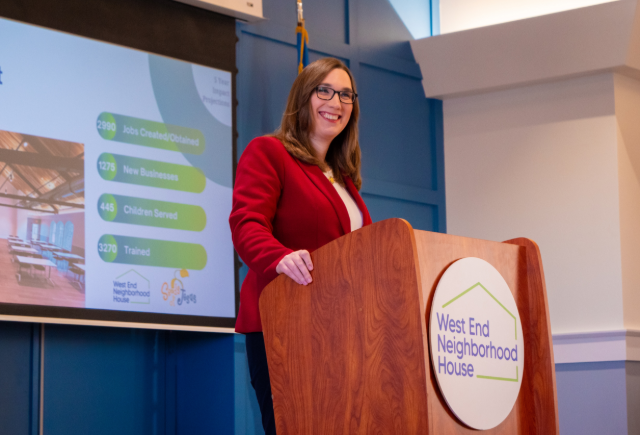 Rep. McBride speaks at the opening West End Neighborhood House's new Education Center. Rep. McBride speaks at the opening West End Neighborhood House's new Education Center.
|
|
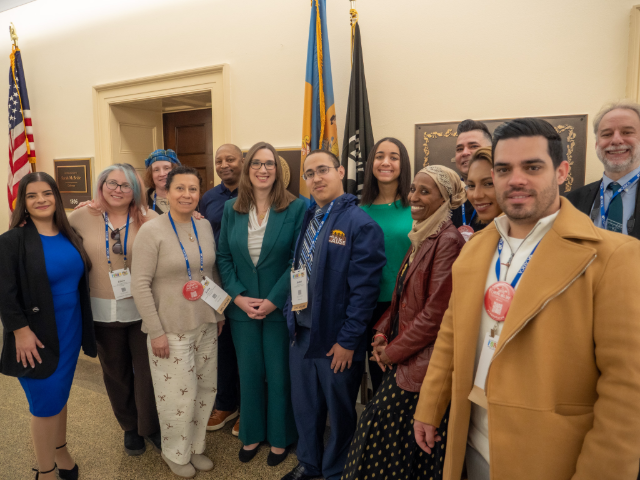 Rep. McBride poses with partners at CADCA outside of her D.C. office. Rep. McBride poses with partners at CADCA outside of her D.C. office.
|
That’s all for this week! I got to focus on a lot of what makes Delaware great, ensuring that the future of our coasts are protected, and supporting my colleagues in calling for change and dramatic reforms of unruly agencies. All in a week’s work.
Talk soon, Delaware.
| Stay in touch, and I'll do the same. |
 |
| Sarah McBride |
| Delaware's Congresswoman |
|
 |
- Applications for the Spring round of EDGE 2.0 are open now! The Delaware Division of Small Business is now accepting applications for EDGE 2.0, the state’s flagship grant competition. This spring, $1.15 million is available to support early-stage businesses, with awards based on the strength of each pitch—not a fixed number of winners. Eligible Delaware-based businesses that have been operating for less than seven years can apply between February 6 and March 6. Learn more and apply at de.gov/edge
- Are you looking to stay up-to-date with Congressional appropriations? Fill out this new form to get onto Rep. McBride’s distribution list for updates about CPFs. The team will reach out to this list when CPF applications open and access the request form for general programmatic and language requests.
- A simple step that can save lives. Smart911 is a free, secure service that lets you create a safety profile with critical information—like medical conditions, medications, disabilities, and emergency contacts—that 911 operators can see when you call for help. That means first responders have the information they need before they arrive, helping them act faster and smarter. Learn more and sign up at www.smart911.com!
- Congressional Art Competition: Each spring, a nation-wide high school arts competition is sponsored by the Members of the U.S. House of Representatives. The Artistic Discovery Contest is an opportunity to recognize and encourage the artistic talent in the nation, as well as in our Congressional District. The deadline to submit your artwork is April 1, 2026. If you know a student interested in applying – please visit: mcbride.house.gov/services/art-competition
- Help navigating a federal agency: If you can't get an answer from a federal agency in a timely fashion, or if you feel you have been treated unfairly, our office may be able to help resolve a problem or get you the information you need. While we cannot guarantee you a favorable outcome, we will do our best to help you receive a fair and timely response to your problem. If you need help navigating a federal agency, please visit: mcbride.house.gov/services/help-federal-agency
|