|
Dear Friend,
Welcome back to the McBride Memo, my weekly dispatch to Delaware! This week had some small wins with big impact. Here are five things you should know about:
1. One big thing: This week, we took an important step towards making our leave systems fairer for families, workers, and communities. I introduced, with bipartisan support, the Flexible Leave Act, which would update the Family and Medical Leave Act (FMLA) so it reflects how working families actually manage caregiving and welcoming a new child.
For most families, bonding with a new child doesn’t happen in a single uninterrupted stretch. Parents may want to spend the first few weeks at home with their child, then stagger their remaining leave—such as with one parent returning to work and staggering their remaining leave. This bill addresses that lived reality.
Simply put: this bill aims to remove barriers by allowing workers to take FMLA leave intermittently or on a reduced schedule, as opposed to relying on the approval of their employer or a doctor. Currently, families are often forced into an all-or-nothing choice that doesn’t allow flexibility to match the needs of raising a newborn or caring for a loved one.
Families and workers do not experience caregiving or health needs in neat, one-size-fits-all blocks of time—and our laws shouldn’t pretend they do.
This is just one more step towards a fairer leave system that honors the lived experience of our neighbors, a priority that will always be my north star. You can read more about the bill and its introduction here.
2. Driving the news: As of tonight, the government will again enter a partial government shutdown. This time because Congressional Republicans refuse to pass needed reforms of the Department of Homeland Security’s immigration enforcement operations to prevent the kind of illegal actions we saw in Minneapolis and around the country by ICE and CBP officers. My colleagues and I have been clear — we will not fund DHS without these reforms.
In better news, this week a bipartisan majority voted to override Trump’s tariffs on Canada. These tariffs are dangerous and destabilizing, and I hear every day how Delawareans are tired of being caught in the crosshairs of the President’s trade war.
Our neighbors are struggling to make ends meet and the consequence of unstable markets is hitting my neighbors where it hurts. Small business owners are also facing the squeeze, with products manufactured overseas spiking in price. Tariffs are an unnecessary and haphazard tax that hurts the bottom line of families, workers, and Americans across the country. My colleagues and I will continue to vote to block these unnecessary taxes on the American people.
3. Committee business: This week, I spoke at a committee hearing on the future of Syria after the fall of the Bashar al-Assad regime. Specifically, whether the United States will meaningfully engage at this critical inflection point in Syria’s history with the presence needed to ensure a stable future for the Syrian people.
Trump’s second term has been defined by a retreat from diplomacy and a dismantling of the very tools that help prevent chaos. From gutting the State Department to hollowing out USAID, this administration has stepped back from the global stage in a major way. As we have stepped back, we have left the door open for our adversaries to fill the void.
In Syria, we’re seeing this play out in real time. Syria has long been embedded in Russian influence–Russia used the Syrian civil war as a testing ground for military tactics it later deployed in Ukraine. Russia is not invested in building a stable Syria, because they thrive on fragility and division.
At this week’s hearing, I made clear that continued U.S. engagement—alongside our NATO allies—is essential to counter Russian influence and to build a stable future for the Syrian people. If we lose our eyes and ears on the ground, we lose the opportunities to foster democracy and protect marginalized people.
Foreign policy may feel far away from Delaware. But instability abroad impacts our military families at Dover Air Force Base, our supply chains, and our national security. We can’t cede ground to regimes that thrive on chaos. And I’ll continue pushing for a foreign policy rooted in diplomacy, democracy, and dignity—because how we show up around the world says everything about who we are at home.
4. Legislative priority: Prices are too high all around the country, and housing is one piece of the pie that has been plaguing families for years. Rent is too high. Seniors on fixed incomes are worried about staying in the communities they’ve called home for decades. And young families are wondering whether they’ll ever be able to buy their first house.
Safe and affordable housing isn’t just another policy debate—it’s the foundation of economic stability, good health, strong schools, and vibrant neighborhoods. If we want to build a more equitable and fair community, housing is one of the first—and most critical—places to start.
That’s why this week I was proud to vote for the Housing for the 21st Century Act—a bipartisan bill that just passed in the House with overwhelming support.
This legislation makes long-overdue improvements to federal housing programs by expanding local development opportunities and modernizing how we support housing across America. It broadens access to homeownership through increased support for manufactured housing and small-dollar mortgages, encourages the development of new affordable homes in communities of every size, and strengthens protections for families in public or federally assisted housing.
Bottom line: this bill helps us build more housing, faster—and makes sure it’s accessible and affordable.
Housing affordability is about dignity. It’s about whether a veteran experiencing homelessness can access stable shelter. Whether a family can build generational wealth through homeownership. Whether a child can stay in the same school year after year. Whether seniors can age in place with security.
I will keep working to ensure that Delaware families—and families across this country—have access to safe, stable, and affordable housing in the communities they love. When we get housing right, we strengthen everything else.
5. Our state of neighbors: Everyone I met this week, teachers, factory workers, health care providers, and faith community members, I was reminded that Delawareans aren’t waiting for a change—they’re creating it. And my job is to show up, listen, and bring their voices and priorities with me to Washington and the work I do. Here are a few of the neighbors I got to meet with:
In Wilmington, I toured Printed Solid, a Delaware-based manufacturer specializing in high-quality 3D printing solutions. Founded in 2013 and recently acquired by Prusa Research, Printed Solid now completes final assembly of 3D printers right here in Delaware for the U.S. market. Walking the facility and meeting with their leadership reinforced how federal manufacturing policy impacts real jobs and real innovation.
I met with leaders from Habitat for Humanity affiliates across Delaware during their annual fly-in to talk about federal housing programs that make affordable homeownership possible. Habitat’s work—through new construction, rehabilitation, and critical repair programs—serves families priced out of the traditional housing market. Our conversation centered on essential federal programs that help lower development costs and expand access to homeownership. I look forward to supporting these programs in the appropriations process this year. Housing affordability isn’t abstract—it’s about whether families in Kent, Sussex, and New Castle Counties can put down roots in the communities they love.
I sat down with Gloria Ho, Director of the Delaware State Education Association, to discuss the impact of federal actions on our schools. We talked about interagency agreements that could shift responsibilities away from the Department of Education and about DHS rolling back guidance that once limited immigration enforcement near sensitive locations like schools. When federal policies create fear or instability in classrooms, Delaware students and educators feel it first. Protecting public education and ensuring schools remain safe and supportive spaces remains a top priority.
During the National Down Syndrome Society’s advocacy conference, I met with Delaware advocates and families to discuss federal disability policy. Many of these advocates have been engaged in federal policy for years, including efforts to expand ABLE accounts and protect access to Medicaid. We celebrated key wins this Congress, including the passage of a bill to prohibit discrimination in organ transplants. These conversations are a reminder that disability rights are about dignity, access, and ensuring families can plan for the future with confidence.
I met with leaders from the Delaware on Main Program during the Main Street America Fly-In to talk about revitalizing our downtowns and neighborhood commercial corridors. Delaware on Main, housed within the Division of Small Business, supports historic downtowns and small businesses across the state. We discussed efforts to strengthen capacity-building and technical assistance for small business districts. When our main streets thrive, local entrepreneurs thrive—and so do the communities built around them.
I met with leadership from Delaware’s Federally Qualified Health Centers (FQHCs) members of the Mid-Atlantic Association of Community Health Centers to discuss FY27 appropriations and state and federal policies that shape access to care. We celebrated the final approval of Delaware’s state provider tax, an effort I led as a State Senator, which will result in a massive infusion of funds into Delaware’s Medicaid program! I’m so grateful to the incredible work our FQHCs do– from Westside and Henrietta Johnson up north to La Red down south– they’re on the front lines of keeping our communities healthy.
I also met with members of the Delaware Association of School Principals. We discussed federal funding streams that are instrumental in helping Delaware students succeed, like Title I funding and programs that provide support for English learners. Principals see firsthand how federal decisions shape student outcomes. Their insights help guide my work to protect and strengthen K–12 education funding for Delaware schools.
In a meeting with Accelerate and education leaders, we discussed high-dosage tutoring and the needs of Delaware’s multilingual learners. In 2025, multilingual learners made up 13 percent of Delaware’s student population—about 19,000 students—speaking more than 100 languages. Yet investment has not kept pace, and only a fraction of schools have certified bilingual or ESL teachers. Ensuring our education system meets the needs of every student—no matter their language background—is essential to equity and opportunity.
I met with advocates from the Alliance for Headache Disorders Advocacy to discuss federal policies impacting Americans living with migraine and other headache disorders. We talked about the SAFE STEP Act and the HEADACHE Act—bills aimed at improving access to care and expanding research. For millions of Americans—especially women—headache disorders are a daily, often invisible challenge. Federal policy can either create barriers or remove them.
I had the honor of serving as the guest speaker at Temple Beth El in Newark. The conversation focused on my first year in Congress and included an extended Q&A with congregation members. These open, community-centered conversations are a cornerstone of representative democracy—neighbors asking questions, sharing perspectives, and holding their elected officials accountable.
At EastSide Charter School in Wilmington, I toured the campus with school leadership and engaged with students. As a Title I school that recently opened the Chemours STEM Hub, EastSide is working to provide students with high expectations and expanded STEM opportunities. Seeing that work up close reinforces why federal investment in education—especially in high-poverty schools—matters so much.
I visited MOT Charter High School to meet with school leadership and congratulate Evina Shingavi, Delaware’s 2025 Congressional App Challenge winner. Evina’s app, Respondify, connects trained volunteers to nearby emergencies in real time. Programs like the App Challenge aren’t just competitions—they’re reminders that Delaware students are already leading with innovation and creativity.
|
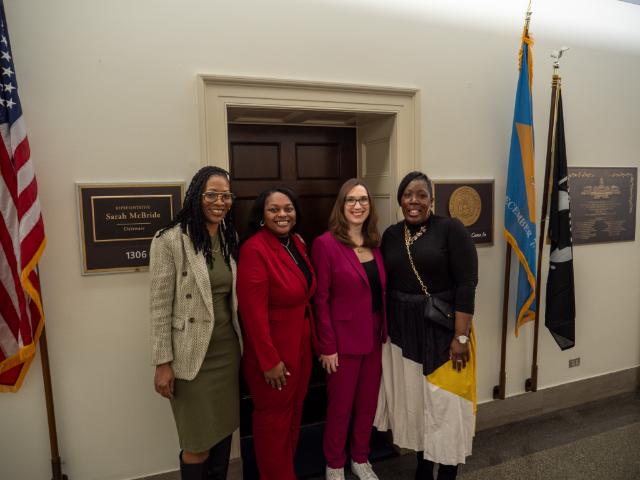 Rep. McBride poses outside her D.C. office with leaders from Milford and Delaware on Main. Rep. McBride poses outside her D.C. office with leaders from Milford and Delaware on Main.
|
|
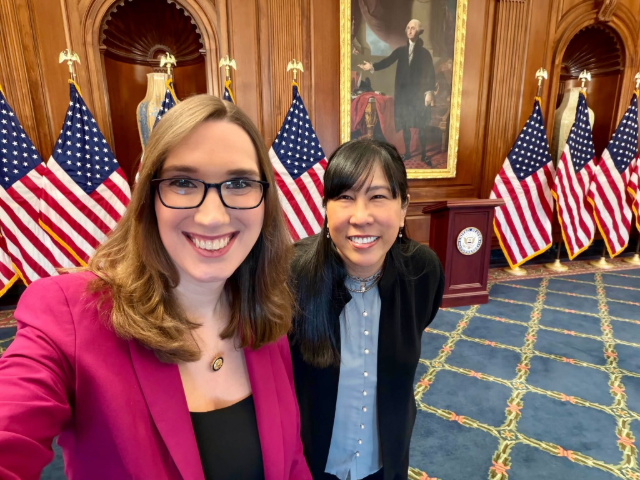 Rep. McBride and Gloria Ho from the Delaware State Education Association take a selfie. Rep. McBride and Gloria Ho from the Delaware State Education Association take a selfie.
|
That’s all for this week! I got to focus on a lot of what makes Delaware great, meet some impressive Delawareans, and work to expand equitable leave for everyone. I hope you each have a restful weekend ahead.
Talk soon, Delaware.
| Stay in touch, and I'll do the same. |
 |
| Sarah McBride |
| Delaware's Congresswoman |
|
 |
- Applications for the Spring round of EDGE 2.0 are open now! The Delaware Division of Small Business is now accepting applications for EDGE 2.0, the state’s flagship grant competition. This spring, $1.15 million is available to support early-stage businesses, with awards based on the strength of each pitch—not a fixed number of winners. Eligible Delaware-based businesses that have been operating for less than seven years can apply between February 6 and March 6. Learn more and apply at de.gov/edge
- Are you looking to stay up-to-date with Congressional appropriations? Fill out this new form to get onto Rep. McBride’s distribution list for updates about CPFs. The team will reach out to this list when CPF applications open and access the request form for general programmatic and language requests.
- A simple step that can save lives. Smart911 is a free, secure service that lets you create a safety profile with critical information—like medical conditions, medications, disabilities, and emergency contacts—that 911 operators can see when you call for help. That means first responders have the information they need before they arrive, helping them act faster and smarter. Learn more and sign up at www.smart911.com!
- Congressional Art Competition: Each spring, a nation-wide high school arts competition is sponsored by the Members of the U.S. House of Representatives. The Artistic Discovery Contest is an opportunity to recognize and encourage the artistic talent in the nation, as well as in our Congressional District. The deadline to submit your artwork is April 1, 2026. If you know a student interested in applying – please visit: mcbride.house.gov/services/art-competition
- Help navigating a federal agency: If you can't get an answer from a federal agency in a timely fashion, or if you feel you have been treated unfairly, our office may be able to help resolve a problem or get you the information you need. While we cannot guarantee you a favorable outcome, we will do our best to help you receive a fair and timely response to your problem. If you need help navigating a federal agency, please visit: mcbride.house.gov/services/help-federal-agency
|