|
Dear Friend,
Welcome back to the McBride Memo, my weekly dispatch to Delawareans.
This week raised real questions about security, democracy, and whether families can get the care they need close to home.
Here are five things you should know:
.png "One_Big_Thing_(1).png")
Delaware has a long tradition of leading the way on protecting our democracy. Last week, Attorney General Kathy Jennings carried that tradition forward and announced two major court victories blocking Trump Administration executive orders that threatened to interfere with how states run their elections.
The courts affirmed what the Constitution makes plain: elections belong to the states and to the people, not to an executive trying to bend the rules for partisan political purposes.
But those victories are not the end of the story. The Trump Administration is finding new ways to try and interfere with our elections. He has sent letters to election officials across the country, raised the threat of prosecution, and is attempting to withhold federal funding to intimidate states into changing how they conduct their elections.
Intimidation does not produce election integrity. It only causes fear, confusion, and distrust. In Delaware, we know democracy only works when every eligible voter can participate without political interference.
I’m grateful for the work of leaders like Attorney General Jennings, who consistently show up for Delaware voters and election integrity, and I’ll keep working alongside elected officials in Delaware to protect our elections from federal overreach — because the right to vote is not a bargaining chip, election workers should not be threatened for doing their jobs, and power in this country should flow from the people, not from a president trying desperately to protect his congressional majority.

President Trump’s war with Iran continued to spiral further out of control this week.
After signing a ceasefire and lifting sanctions in June, Trump left a major point of leverage in Iran’s hands: the Strait of Hormuz, the narrow waterway that carries roughly a fifth of the world’s oil. On Monday and Tuesday, Iran used that leverage by striking commercial tankers near the strait. Trump responded by authorizing strikes on Iranian targets, reimposing oil sanctions, and declaring that the ceasefire is now over.
None of this is surprising. It’s the predictable result of a war started without clear objectives and with no plausible strategy. Trump launched strikes, negotiated away our leverage, got nothing durable in return, and left Iran with an economic weapon of mass destruction. And now, Iran is using that weapon — its control of the strait — to endanger American lives and derail negotiations to end its nuclear program.
Before Trump was involved, we had a nuclear deal and open access to the Strait of Hormuz. But since taking office, he has ditched diplomacy and chosen a path that’s killed innocent civilians, sacrificed our servicemembers, spiked prices, disrupted the global energy supply, and made life more difficult for folks across the First State — many of whom are already stretched thin by the cost of groceries, housing, and healthcare.
Delawareans deserve leadership that keeps us safe and lowers costs — not a president whose chaos abroad makes life more expensive here in Delaware. I’ll keep pushing for accountability, diplomacy, and a foreign policy that protects Americans at home and promotes our values abroad.

Amid escalating tensions in his war with Iran, President Trump joined some of our closest allies for the 2026 NATO Summit in Turkey.
The summit produced important commitments: reaffirming Article 5, continuing support for Ukraine, and increasing coordination across the alliance. Those are the right priorities, and I’m grateful for any moment when our allies can stand together with clarity and resolve.
The importance of a unified NATO cannot be overstated. It tells our allies that America understands its responsibilities. And it reminds the world that democracies are strongest when we keep our promises to one another.
But once again, Trump undercut NATO’s demonstration of unity with reckless and petty political threats. He revisited his obsession with U.S. ownership of Greenland. He continued to question whether NATO countries would show up for America. And he threatened to cut economic ties with allies who disagreed with him.
That’s how alliances are weakened, not strengthened. You cannot praise unity while treating our allies like adversaries. You cannot defend sovereignty in Ukraine while threatening the sovereignty of Greenland. And you cannot keep Americans safe by turning our alliances into political bargaining chips.
At its best, NATO is a series of promises: that democracies are worth defending, that borders cannot be redrawn by force, and that an attack on one ally is an attack on all. Those promises keep our servicemembers safe, strengthen our economy, and promote the stability and safety that Delaware families rely on every day.
As a member of the House Foreign Affairs Committee and a concerned American, I’ll keep pushing for a foreign policy rooted in dignity, democracy, and accountability — because America is safest when we lead with steadiness and respect, not chaos and threats.

July is National Minority Mental Health Awareness Month, a reminder that mental healthcare must be accessible, trusted, and rooted in dignity for every community.
I’m proud to cosponsor the Expanding Access to Mental Health Services in Schools Act, legislation to help high-need school districts recruit, hire, retain, and diversify school-based mental health professionals.
Schools should have the resources they need to support students with tailored guidance and culturally competent care — because every child deserves to feel safe, supported, and seen.
For too many students — especially students of color and students from underserved communities — getting mental health support can mean long waitlists, high costs, or care that does not reflect their lived experiences. That’s a problem we have a responsibility to address.
This bill would help expand counseling, social work, and other mental health services in schools across the country. As a result, fewer children would fall through the cracks and more families would get help before a challenge becomes a crisis.
In our state of neighbors, we know that the ability to get help should never depend on a neighbor's ZIP code, their family’s income, or their racial identity. That’s why I’ll keep working to build a future where every student has the support they need to thrive, every family can access care they can trust, and every community is treated with the dignity it deserves.

That same principle — that care should be accessible, trusted, and rooted in dignity — is the reality I am working to achieve across our state, including our rural communities like those in Sussex County. It’s why I penned an op-ed this week in the Cape Gazette about the state of healthcare access for our neighbors downstate, exactly one year after the largest cut to Medicaid in American history.
Sussex County is the fastest-growing part of our state, home to more and more older Delawareans, young families, and neighbors who should be able to count on quality, affordable healthcare without driving hours or crossing county lines.
But one year after President Trump and Congressional Republicans passed their so-called “One Big Beautiful Bill,” communities like Sussex are being asked to do more with less. Cuts to Medicaid and federal healthcare funding are placing additional strain on a system that’s already stretched thin. The result? Longer wait times, fewer providers, higher costs, and more pressure on the hospitals and clinics folks in the First State rely on.
That means expectant parents struggling to find OB-GYN care close to home. Cancer patients traveling long distances for lifesaving appointments. And teenagers searching for mental health support and facing long waitlists and limited resources.
That’s not the future any community in Delaware deserves. Healthcare is about more than convenience. It is about security, dignity, and the promise that no matter where you live — from Wilmington to Dover, from Newark to Seaford — your life and your health matter.
As I said in the Cape Gazette, I’ll keep working to protect Medicaid, strengthen rural healthcare, expand mental health services, and lower costs for every one of my neighbors in Delaware — because no ZIP code should be a barrier to a life well lived. You can read my piece in full by clicking here.
|
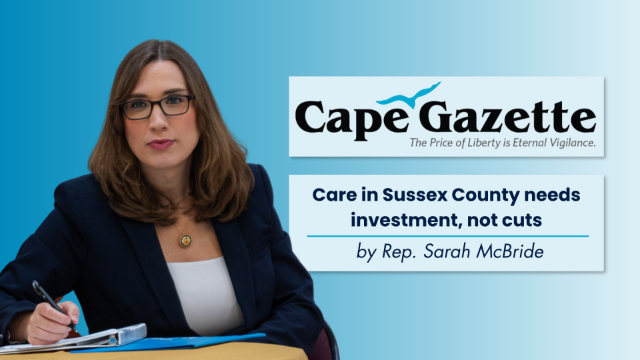 Rep. McBride, pictured writing, alongside the logo of the Cape Gazette and the title of her piece in the Cape Gazette. Rep. McBride, pictured writing, alongside the logo of the Cape Gazette and the title of her piece in the Cape Gazette.
|
That’s all for this week’s McBride Memo.
I know we covered a lot of ground — NATO, Iran, elections, healthcare access across Delaware. But all of these issues come back to the same basic premise: that people deserve safety, dignity, and a government that works for them.
Thank you for reading along and allowing me to do this work.
Whatever you are up to this weekend, I hope it’s a good one.
Talk soon, Delaware.
| Stay in touch, and I'll do the same. |
 |
| Sarah McBride |
| Delaware's Congresswoman |
|
 |
- Service Academy Nominations: Our office is accepting applications from Delaware students seeking nominations to our nation’s prestigious service academies! As a member of Congress, it is my honor to support these students in their efforts to serve our nation in uniform. The application deadline is October 15th and you can find more information on eligibility and application requirements here.
- Congressional App Challenge: Calling all young coders! The Congressional App Challenge is now open to all middle and high school students in Delaware. This nationwide competition is a chance to flex your creativity, build real-world STEM skills, and develop your very own app. The winner will also be invited to the national #HouseOfCode celebration in D.C.! Learn more and get started here.
- Help navigating a federal agency—If you can't get an answer from a federal agency in a timely fashion, or if you feel you have been treated unfairly, our office may be able to help resolve a problem or get you the information you need. While we cannot guarantee you a favorable outcome, we will do our best to help you receive a fair and timely response to your problem. If you need help navigating a federal agency, please visit: https://mcbride.house.gov/services/help-federal-agency
|