|
Dear Friend,
Welcome back to the McBride Memo, my weekly dispatch to Delawareans.
It was another busy week in Washington, with plenty of news and conversations that I would like to share with you all. From artificial intelligence to storm preparedness, here are five things you should know this week:

Artificial intelligence presents potentially the biggest change for humanity since human beings went from nomadic creatures to stationary, community-based societies. That kind of dramatic change comes with serious challenges — that’s why I joined my Democratic colleagues this week in calling on Speaker Johnson to keep the House in session until Congress advances meaningful, bipartisan safeguards for AI. Instead, Speaker Johnson sent us home a day early.
Whether you think AI will be a fountain of youth or a doomsday technology or something in between, its power — both present and potential — is indisputable. Its capacity to cure diseases or produce bioweapons, to protect against the most advanced cyberattacks or hack the most robust technological fortresses, to foster shared prosperity for the many or to amass unimaginable wealth for the few, are each different sides of the same coin: significant capacity that can lead to superhuman power.
No concentration of such power — whether it be in an individual, a company, a nation, or a technology — can be allowed to go unchecked or unrestrained. And it certainly cannot go unregulated.
Since I entered Congress, I’ve been calling on my colleagues to meet this moment and to marshal our collective power to regulate AI. It’s why, as a member of the Science, Space, and Technology Committee, I’m pushing for regulations domestically and, as a member of the Foreign Affairs Committee, I’ve argued for an “arms control” approach to AI globally. We need human-centric laws that protect our economy, our finances, our privacy, our health, our democracy, and, yes, our existence. We need national and international action. We need it now.
For AI to have any good, we must protect against its harm. And the clock is ticking. As we’ve seen with other technologies, the longer we wait, the harder it becomes. We cannot feel too much urgency. We cannot be too imaginative. There is simply no realistic risk in today’s politics that we do too much. The risk is that we do too little — and that is a risk that is simply too great to bear.
Whistleblowers are warning us. AI CEOs are requesting it. And the people are demanding it. Congress should not rest until we’ve fulfilled our responsibility to our constituents and to humanity. Future generations expect nothing less.

Trump’s war with Iran has now surpassed the seven-month mark, and some shocking receipts are starting to roll in. The Congressional Budget Office released a report this week that says Trump’s war has directly cost taxpayers roughly $38 billion, but available reporting suggests that the monetary cost of this conflict is likely much higher.
Here in the First State, we know that the costs of this war cannot merely be measured in Department of Defense expenditures. My neighbors are paying for Trump’s recklessness at the pump, with gas hovering around $4.35 per gallon and diesel comfortably above $6 per gallon (the highest recorded average in history). Government officials have highlighted that this war has depleted U.S. weapons stockpiles. And 18 servicemembers have been killed, while hundreds more have been injured.
Americans are paying an unimaginably steep price for this conflict, and they’ve gotten nothing in return. Trump promised a 4-6 week timeline and total surrender from the Iranian regime. Seven months in, however, the conflict is widening, allies are suffering, and we are further from an Iran-nuclear deal than we were at the start. I voted for and the House passed another War Powers Resolution this week to rein in President Trump’s reckless war of choice. The Senate must immediately follow suit because the American people simply cannot afford for this chaos to continue.

This week, at our Science, Space and Technology Committee hearing, I asked a simple question: If we want new technology to help us prepare for disasters, why would we weaken the federal data systems that these tools rely on?
For farmers in Sussex County and across Delaware, extreme weather can bring flooding and saltwater intrusion that damages crops, harms soil, and turns productive farmland into marsh. AI tools can help farmers anticipate those risks and prepare earlier — but AI is only as useful as the data it is trained on. Earlier this year, the Trump Administration tried to scale back the Ocean Observatories Initiative, a network of buoys and instruments that provides critical ocean data. Moves like that undermine access to the information we need to understand hazards before they become disasters.
I asked subject-matter experts about what happens to disaster forecast accuracy when mission-critical data sources are compromised. We also talked about what Congress can do to make trusted federal data easier for everyday Americans to access and put to work.
Delawareans have legitimate questions about AI — from privacy and safety to energy demand and the environment — and Congress has a responsibility to put appropriate safeguards in place. Alongside those safeguards, we need to protect, not scale back, the research and reliable federal data these technologies depend on. Our farmers, Delaware families, and safety professionals deserve the best information available to help them prepare before disaster strikes. You can watch my full remarks here.

As the state with the lowest mean elevation in the country, we know how important it is to take a proactive, all-of-the-above approach to preparing for rising waters and severe storms. That’s why I’m excited to share that the bipartisan Water Resources Development Act passed out of the House this week — and that it includes several Delaware priorities I worked hard to secure.
The bill authorizes new Army Corps projects to strengthen flood and shoreline protections along the Delaware River, reduce flood risks in New Castle, and explore additional coastal protections along the Assawoman Canal in Sussex County. It also strengthens support for water infrastructure throughout the Delaware River Basin.
Waterways are part of who we are here in Delaware — our rivers and beaches support businesses and our economy, bring neighbors together, and help define the culture of our state. Investing in their resilience means protecting the homes, businesses, shorelines, and communities that Delawareans have been building for generations.
That work is critically important; you don’t prepare for a storm after it has already begun. I’ll keep working with local leaders and federal partners to move these projects forward and make sure Delaware is ready for whatever challenges may lie ahead.

I love getting to spend time with Delawareans who are building, caring, serving, and solving problems in every corner of our state, and this week I got to meet with some incredible folks who are doing exactly that:
I started the week in Edgemoor for the groundbreaking of the new Delaware Container Terminal at the Port of Wilmington, alongside labor leaders, community partners, and elected officials. The Port has supported generations of Delaware families, and this expansion has the potential to create thousands of union jobs, strengthen our supply chains, and open new pathways into family-sustaining careers. But growth only works when the people living around it share in the opportunity. That means listening to our neighbors, protecting the surrounding community, and making sure this once-in-a-generation investment translates into good jobs and a stronger Wilmington.
Back in Washington, I met with Delaware advocates from the American Cancer Society Cancer Action Network, including oncology nurse Darcy Burbage and Matt Wilson, a 15-year pancreatic cancer survivor. We talked about protecting cancer research and prevention programs, expanding access to clinical trials, and making sure cost or circumstance never stands between a patient and lifesaving care. Cancer touches so many families across the First State, and progress comes from pairing the expertise of researchers and healthcare workers with the voices of survivors and advocates who know firsthand what is at stake. Every breakthrough means more birthdays, more time with family, and more hope. I will keep working to help make that a reality.
I met with representatives from the Delaware Automobile and Truck Dealers Association, who stopped by our office to talk about the challenges facing dealerships and the families and businesses they serve. These folks are local employers with deep roots in communities like Milford and Smyrna, and we discussed the costs and regulations affecting their businesses. Good policy should protect consumers, keep communities safe, and give responsible local businesses room to succeed.
I also met with leaders from Veterans of Foreign Wars of Delaware, to discuss mental healthcare, disability compensation, and legislation like the Major Richard Star Act, which I’m proud to cosponsor and which would help ensure combat-disabled veterans can receive the benefits they have earned. When someone puts on the uniform, our obligations to them do not end when their service does. Keeping faith with our veterans means making sure they can access the care, benefits, and dignity they were promised.
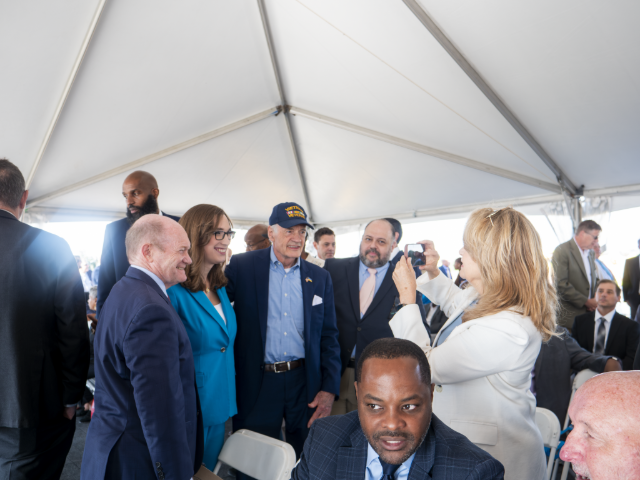 |
| Rep. McBride smiles for a picture with U.S. Senator Chris Coons and former U.S. Senator Tom Carper at an event for the new Delaware Container Terminal at the Port of Wilmington. |
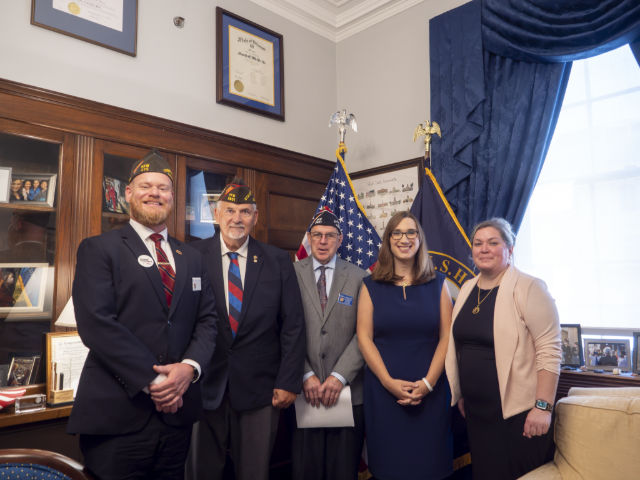 |
| Rep. McBride stands alongside representatives from Veterans of Foreign Wars of Delaware after their meeting at her Washington, D.C. office. |
The challenges ahead won’t be solved by Washington talking to itself; they will require listening to the people who will live with the consequences of the decisions that we make — workers, families, veterans, small business owners, healthcare providers, and my neighbors across Delaware. My conversations with you all will keep guiding my work, and I’m grateful everyday for the opportunity to do this work.
Whatever you are up to this weekend, I hope it’s a good one.
| Stay in touch, and I'll do the same. |
 |
| Sarah McBride |
| Delaware's Congresswoman |
|
 |
- Service Academy Nominations: Our office is accepting applications from Delaware students seeking nominations to our nation’s prestigious service academies! As a member of Congress, it is my honor to support these students in their efforts to serve our nation in uniform. The application deadline is October 15 and you can find more information on eligibility and application requirements here.
- Congressional App Challenge: Calling all young coders! The Congressional App Challenge is now open to all middle and high school students in Delaware. This nationwide competition is a chance to flex your creativity, build real-world STEM skills, and develop your very own app. The winner will also be invited to the national #HouseOfCode celebration in D.C.! Learn more and get started here.
- Help navigating a federal agency—If you can't get an answer from a federal agency in a timely fashion, or if you feel you have been treated unfairly, our office may be able to help resolve a problem or get you the information you need. While we cannot guarantee you a favorable outcome, we will do our best to help you receive a fair and timely response to your problem. If you need help navigating a federal agency, please visit: https://mcbride.house.gov/services/help-federal-agency
|