|
|
|
LAST THREE WEEKS IN REVIEW |
|
Good morning. I’m your Representative in Congress, and I write to keep you informed. |
|
|
|
| A ‘champion’ for community health centers |
|
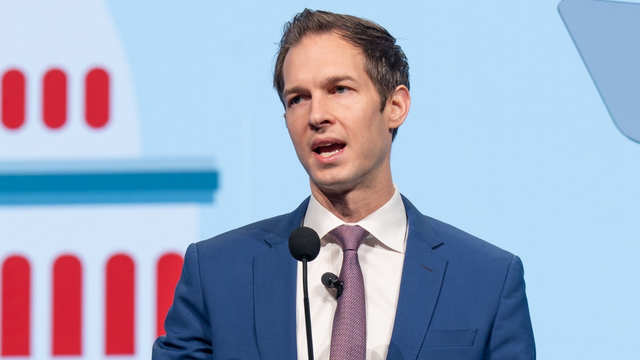
Strengthening the backbone of primary care: I addressed community health center leaders from across the country at the annual meeting of the National Association of Community Health Centers (NACHC) in Washington. Amidst the challenge of Medicaid cuts, I identified three opportunities to strengthen health centers as the backbone of primary care in the United States:
- Securing bipartisan champions to triple funding for health centers through Section 330 grants. There's not much that RFK Jr. and I agree upon, but funding community health centers is one. Last month’s Health Appropriations was adequate (and just in time) for community health centers, and we should build on that base level
- Weighing in early on Section 1115 negotiations with big, bold ideas for expanding health center reach. Section 1115 waivers are negotiated every five years between state and federal Medicaid agencies. They are a hidden fulcrum of health care reform, because they set the parameters for rules and funding for every state's Medicaid program, which in the case of Massachusetts, is half our budget and serves over 40% of our children.
- Protecting 340B prescription drug discounts for health centers while preventing the program from buckling under surging over-use.
Earlier this month I co-led the Community Health Center Drug Pricing Protection Act, which would exempt Community Health Centers (CHCs) and Federally Qualified Health Centers (FQHC) from the Trump administration’s proposed 340B Rebate Model Pilot Program. The bill would exempt FQHCs and CHCs from rebate-based pricing by prohibiting manufacturers from charging more than the 340B ceiling price at the time of purchase. This would provide CHCs and FQHCs with financial reprieve in the near-term while lawmakers continue to negotiate on the 340B Program.
When asked afterwards why I'm such a strong supporter of health centers, I answered simply that — in a health care system that so often feels broken — “these health centers work.” Policy should not only fix what's broken, it should also reinforce what's working. I was proud to receive an award from NACHC as a ‘National Champion’ and I'll continue to partner with these providers of primary and preventative care. |
|
| Defending the FDA & focusing on Alzheimer’s research |
|
|
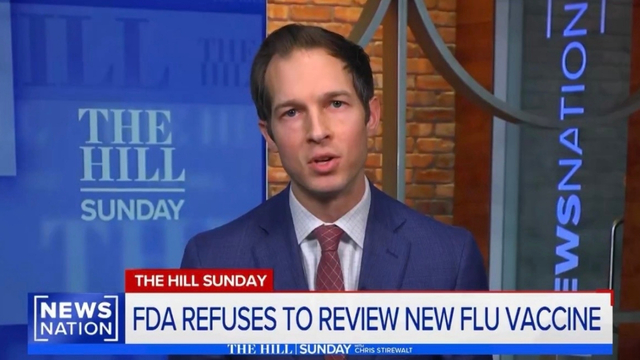
Defending safety & efficacy against fear & favor at the FDA: Two weeks ago, the Food and Drug Administration’s (FDA) Chief Medical and Scientific Officer Vinay Prasad – a political appointee who rose to prominence on Twitter – overruled the FDA’s top vaccine scientist to reject Moderna’s mRNA vaccine application.
I joined News Nation to discuss how this is the latest in a pattern of incompetent decisions and poor stewardship by FDA leadership that is undermining the world's gold-standard biomedical regulator. One former FDA commissioner told me that the FDA has hemorrhaged 20 years of competence and credibility in just the last year. The FDA later reversed course and approved a modified mRNA application from Moderna.
mRNA is the “‘software of life,”’ translating genetic code into the proteins that carry out the functions of the cell. Engineering mRNA allows scientists to rapidly design vaccines, regenerate tissue, and ultimately even design cancer immunotherapy – a personalized ‘cancer vaccine’.
Politics at the FDA threatens this progress. I will continue to support the scientists who believe in evidence about safety & efficacy.
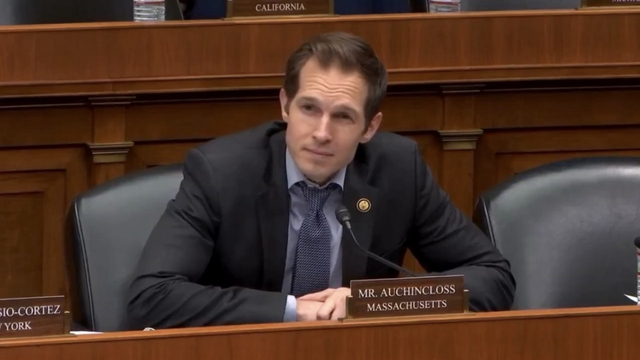
Demanding a hearing on the FDA commissioner: In recent weeks, I’ve dialed up the pressure for FDA Commissioner Marty Makary to testify under oath before the Health subcommittee about his abysmal leadership of the FDA.
I am still waiting to receive an answer to my questions and assertions laid out in three letters I have sent to the FDA about the unethical, unwise, and illegal Commissioner’s National Priority Voucher program, which allows drug reviews to be expedited at the commissioner's discretion and rewards companies with ties to MAGA over those with true scientific merit.
Now, I am pressing the committee’s GOP to do its job and bring Makary to testify. FDA employees, patients, and innovators deserve so much better than the commissioner they have been saddled with.
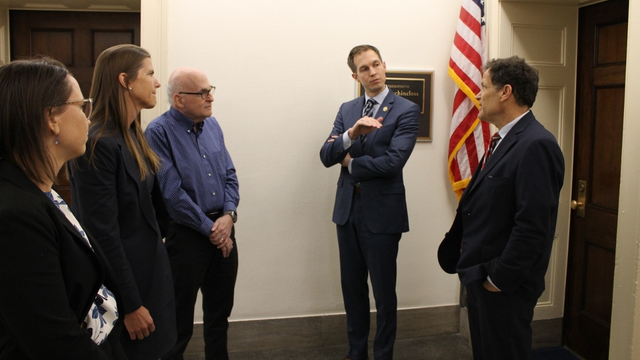
Discussing the state of science on Alzheimer’s: I believe America's flagship scientific enterprise should be treating Alzheimer's Disease. Alzheimer's levies a staggering medical, emotional and financial burden. By 2050, 15 million Americans could be living with the disease, each requiring up to three caregivers. That's 60 million Americans sidelined by dementia, causing widespread suffering and costing more than $1 trillion a year.
Dr. Paul Aisen is a world authority on Alzheimer's and the Director of the USC Alzheimer's Therapeutic Research Institute. I met with Dr. Aisen and his colleague, Dr. Dana Goldman, the director of the USC Schaeffer Institute, which advises on health policy & economics. We discussed the state of the science on Alzheimer's R&D and the state of the art on Alzheimer's policy.
Dr. Aisen explained that two injectable medicines on the market can clear out amyloid plaque in the brain of patients, slowing cognitive decline. The next goal is to make already developed blood tests for that plaque widely available, so that starting at age 50 Americans can screen for the early signs of Alzheimer’s, years before symptoms develop. By taking the amyloid-clearing medicines years in advance of symptoms, the onset & pace of decline of Alzheimer’s can be meaningfully delayed.
In the longer term, the R&D goal is to fully prevent the disease by using small-molecule drugs to prevent amyloid plaque from developing at all.
Dr. Goldman, the health economist, and I discussed what policy measures could support Alzheimer’s R&D. Aside from obvious & important funding for basic research, we also reviewed how to make clinical trials faster & more effective, and whether it makes sense for Medicare to cover diagnostic and preventive interventions well before age 65, as it does for kidney failure.
|
|
Should Medicare cover an early screening for Alzheimer’s for all Americans before 65? |
|
|
| Policies to unlock more energy & more housing |
|
|
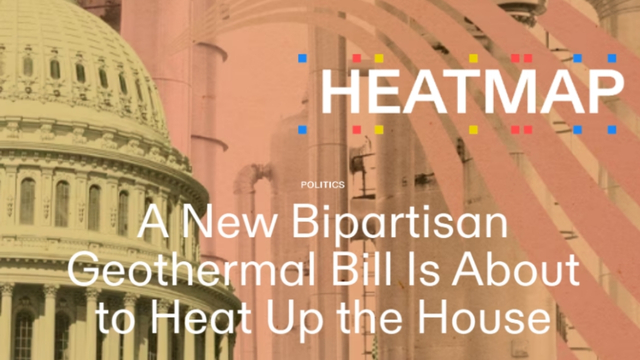
Building America with next-generation geothermal: Earlier this month, I introduced a bipartisan bill — The Hot Rock Act — to promote clean, affordable, baseload power across the United States. The Hot Rock Act supports research, testing, and development of one of the most promising clean energy technologies: superhot geothermal.
Superhot geothermal, invented at MIT, uses plasma to drill deep, tapping into heat stored in rock or fluid at temperatures of 300 degrees Celsius or greater. The technology is still developing, so my bill offers R&D funding, workforce training, and regulatory relief to help kickstart it. This strategic industry has huge potential: lower utility bills, more jobs, climate action, and greater leverage in energy diplomacy.
Clean, cheap & abundant energy is the most important industrial policy the United States can pursue. Promoting superhot geothermal is a big, bipartisan opportunity to make progress. As Heatmap recently put it, “the potential is enormous.”
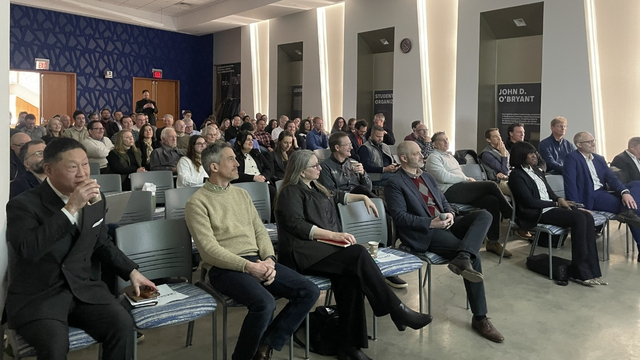
Five levers for federal action on housing: I joined the Northeastern Housing Symposium to discuss light-touch industrial policy for housing. America needs to build at least 5 million homes to make homeownership attainable for the middle class. There are five levers of industrial policy that federal & state governments can integrate for action (hat tip to Niskanen Center & Steve Teles for the thought leadership):
- Push & pull the R&D for housing development, from building materials to automation & digital design systems. Government supports energy, aerospace, and pharmaceuticals with R&D much more than housing, yet the productivity of housing construction has actually declined in recent decades.
- Aggregate demand & reform procurement to unlock Wright's law for housing production (cost per unit declines as volume increases). At the federal level, both the military and FEMA could make big purchases for base housing & disaster-relief units.
- Lower the cost of capital through loan guarantees, outcome-based grants and insurance partnerships.
- Harmonize & rationalize building & land-use regulations into performance-based standards that are consistent across time & space.
- Assemble parcels into large, developable sites & de-risk the water, energy & mobility infrastructure.
In addition to pursuing each of these five industrial policies as distinct efforts, the government can do all five at once by partnering with the private sector to build new cities, as California Forever is currently doing. |
|
| Root-level reforms at ICE |
|
|
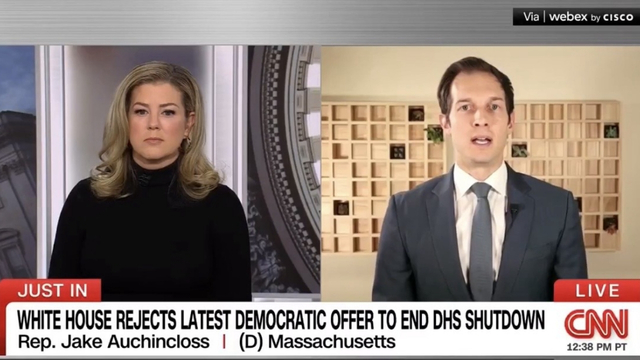
Advocating for root-level reforms at DHS: Nobody is above the law in this country, especially those entrusted to enforce it. I've continued to reject appropriations for ICE, which this administration has morphed from a law enforcement agency to a presidential paramilitary.
On CNN, I explained that although the ICE surge in Minnesota has ended, the fight for root-level reforms has not. Democrats’ demands are squarely in line with Americans’ common sense:
- Guns & masks do not mix. Take off the masks, put body cameras on.
- End the dragnet operations & warrantless searches; focus on criminals & border security.
- Fix the training and use-of-force protocols. Hold agents accountable, including to state & local authorities, for violations of due process.
|
|
| Foreign policy update: Iran & Ireland |
|
|
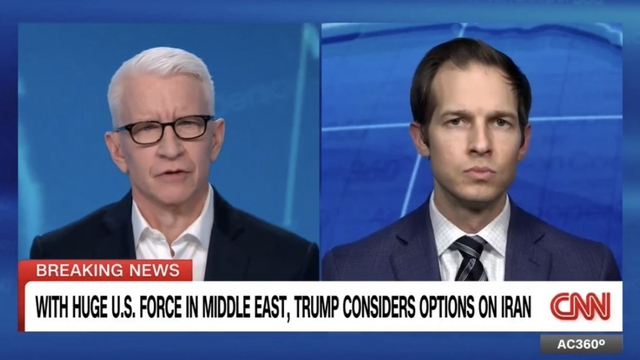
Influencing the succession plan in Iran: Last week, I joined AC360 to discuss the largest US military buildup in the Middle East since Operation Iraqi Freedom. There is a matrix of four facts and two imperatives. The facts are:
1. The Iranian regime wants more ballistic missiles and a nuclear weapon.
2. The Iranian regime does not have control of its skies above 10,000 feet.
3. The Iranian regime does have control of its repressive police state.
4. For now. The Ayatalloh is dying and there will soon be a succession.
Based on these facts, there are two imperatives:
1. Any action by the United States would be wise to use fact (2) to address (1) and fact (4) to address (3). That is, prevent weapons development only with aerial strikes; and influence the succession to unwind repression.
2. The president must come to Congress to debate, authorize, and solidify any plan of action. He has no authority to strike Iran absent congressional authorization.
Any authorization for the use of military force would need to be tightly scoped, by time, place, and manner, and should also include congressional intent about what actions Iran could take to rejoin the community of nations. In this manner, Congress could reclaim war powers; prevent boots on the ground or escalation; and signal to prospective successors to the Ayatollah that the moderate path has potential.
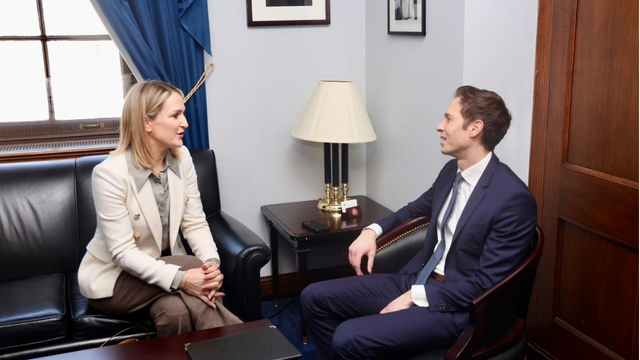
Reinforcing Irish-American ties: The foreign minister of Ireland, Helen McEntee, met with me to discuss our nations' alliance. This president's behavior has embarrassed the United States overseas and shaken our NATO allies, so it is important to conduct congressional diplomacy as a stabilizer. I expressed my continued strong support for Irish-American ties in general and the historic economic and cultural bond between Ireland and Massachusetts, in particular.
I also spotlighted one domain for future collaboration: marine science & technology. Massachusetts is becoming a hub for uncrewed maritime systems, and Ireland is investing in surface & sub-surface domain awareness to protect transatlantic cables from Chinese & Russian sabotage. |
|
| Safeguarding education funding with the power of the purse |
|
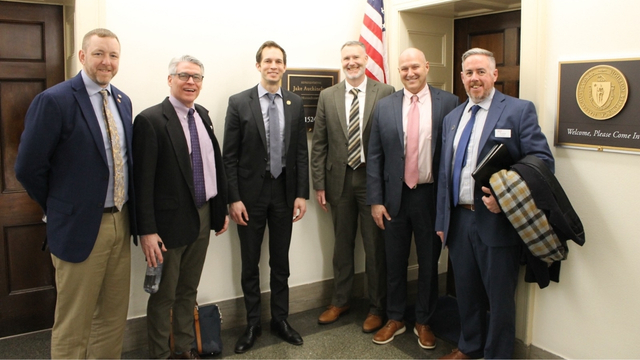
Safeguarding education with the power of the purse: In separate meetings with the Brookline School Committee and school administrators from across Massachusetts, I reviewed important wins for K-12 funding in just-passed Appropriations. Given the administration’s hostility to the Department of Education, K-12 administrators have been planning school budgets not knowing what holes they may need to plug.
Congress took back the power of the purse and plugged those holes. Funding for the main K-12 formula grant programs are maintained at current levels:
- Title I-A local grants: $18.4 billion (+$20 million)
- IDEA state grants: $14.23 billion (+$20 million)
- Title II professional development state grants: $2.2 billion
- Title III English language acquisition grants: $890 million
- Title IV-A Student support and academic enrichment state grants: $1.4 billion
- Title IV-B Afterschool activities state grants: $1.3 billion
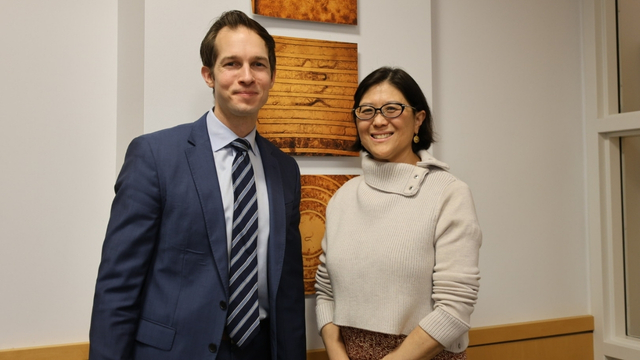
Olin College President May Lee: In Needham, I met with May Lee, Olin College of Engineering’s new president. Higher education has had a volatile five years, and we discussed her ideas for how research institutions and universities can forge a new compact with the American public, seven decades after Vannevar Bush and the Endless Frontier. I hosted my climate action conference at Olin several years ago and look forward to further collaboration with this great college going forward. |
|
| Corruption update: $Trump & Epstein |
|
|
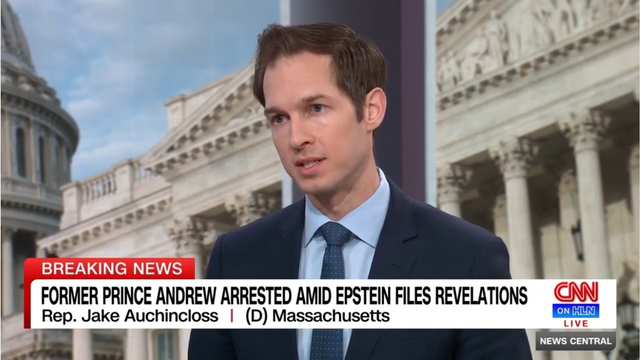
Holding the powerful and privileged to account: Prince Andrew’s arrest last week was the most high-profile case yet of Great Britain holding its powerful and privileged to account. The United States of America should do the same.
It was only because Democrats in Congress called the question that we have these files at all. However, the documents that have been released are redacted in a manner that continues to protect the powerful, including Donald Trump, while, in some cases, revealing the names of victims.
Along with Democrats in the House and Senate, I will continue to press the Department of Justice to release files without fear or favor.
Taking on Trump crypto’s stunt: This month, I pressed Treasury Secretary Scott Bessent for urgent clarification regarding the $500 million deal between a United Arab Emirates firm and the Trump family’s crypto company, World Liberty Financial. The letter asks the Department of the Treasury to explain what safeguards exist to prevent foreign government-linked or politically connected investors from using the bank-chartering process to gain leverage over the US financial system, and to clarify the roles of the White House, the Office of Management and Budget, and Treasury itself in reviewing or influencing Office of the Comptroller of the Currency chartering decisions.
At the beginning of his presidency, Donald Trump and his family issued $TRUMP meme coins, comprising the majority of the Trump family’s net worth. This ongoing crypto stunt has allowed Trump to personally enrich himself by selling the presidency off to the highest bidders. Anyone, including the leaders of hostile nations, can covertly buy these coins.
I have raised concerns alongside Senator Warren and called for an investigation into the meme coin scheme, as well as sponsoring legislation to ban the practice. |
|
| In Newton with the Price Center & Chamber of Commerce |
|
|
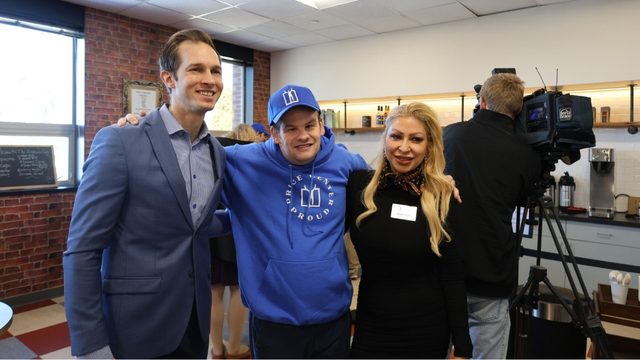
The Price Center in Newton, which provides habilitation services for individuals with developmental disabilities (IDD), launched The Kindness Cafe. The on-site cafe provides barista training, with the ultimate aim of job placement for the IDD baristas. I joined the kick-off to speak with the baristas-in-training, meet Price Center leadership, and offer my support for initiatives that promote IDD employment.
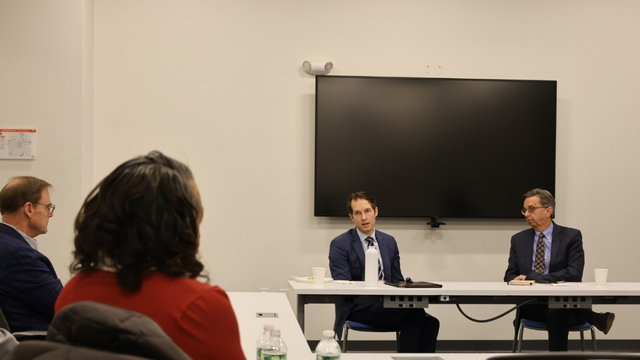
The Charles River Chamber invited me to be its inaugural speaker to the President's Circle, a small gathering of C-suite executives for businesses & non-profits in the Newton, Needham, Watertown & Wellesley geography. We discussed clashes in Congress over ICE and the rule of law, as well as 'Quiet Congress' progress on reforms to drug-pricing middlemen (just passed into law), funding for community health centers and the NIH (just passed into law), and permitting reform for housing & energy (passed in separate chambers but not yet reconciled).
We also had an elucidating back-and-forth on technology & regulation critical to the Massachusetts economy, including biotech, AI and regional banking. I put forward my 'Built not Bot' framework for AI, in which the U.S. economy should adopt this general-purpose technology to lower prices & build better, particularly in healthcare & housing, while rejecting the power of the social media platforms to extract ever-more attention & money from Americans using AI bots. |
|
| In Taunton with local business and the Boys & Girls Club |
|
|

I started a day in Taunton meeting with the five members of the state delegation for Taunton & Raynham. There were three Republicans and two Democrats, and we had a productive bipartisan conversation about school funding, water infrastructure, South Coast rail, and other issues for overlapping federal & state action.

I then joined the Taunton mayor to meet with the founders of Treetop Tutoring, a non-profit that provides 1:1 tutoring to students in many cities & towns. I have introduced federal legislation to help fund 1:1 tutoring with a tax on the social media corporations, and I'm always excited to meet & learn from the tutors themselves, who are so critical to reversing post-Covid learning loss and improving reading & math outcomes for students.
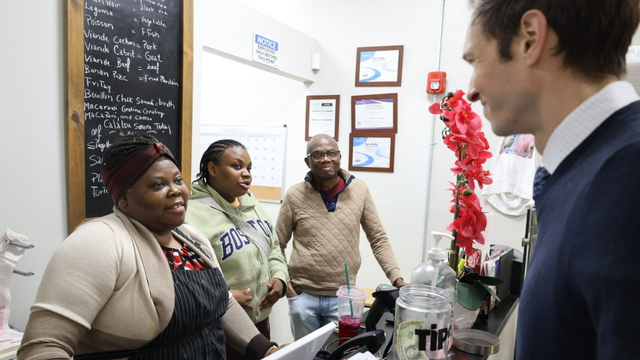
The Taunton Area Chamber of Commerce and state delegation then also joined me at visits to Rob Roy Academy, a cosmetology school, and Adonai Cuisine, a Haitian restaurant in downtown Taunton. Both the young students at Rob Roy and the older Haitian wife-and-husband immigrants who founded Adonai shared with me their entrepreneurial energy that is the engine of Main Street America.
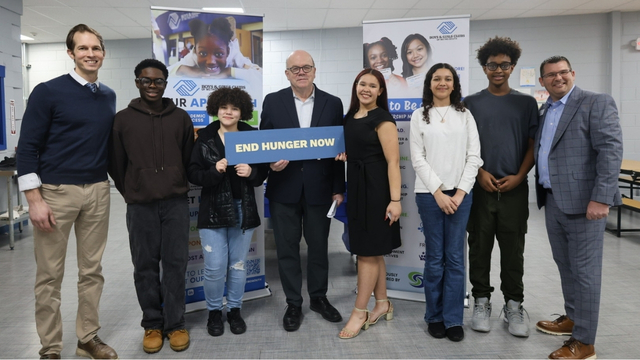
The day ended at the Boys & Girls Club of Metro South, where Congressman Jim McGovern joined me to discuss food security with the Club's leadership and the teenagers who spend their days there. Congressman McGovern is a national leader on the policies & moral urgency to address hunger.
What we saw & heard at the Boys & Girls Club is impressive: they are growing vegetables hydroponically on site, cooking fresh & varied cuisine with a Michelin-starred chef, and giving teens a sense of ownership over their health by including them in both the growing and cooking. |
|
| Congressional update and Q&A in Foxborough |
|
|
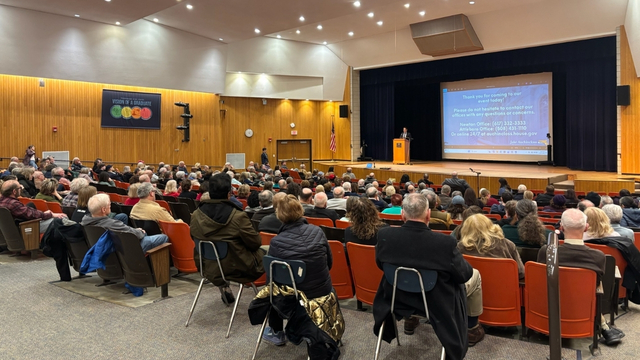
Right before the snow started falling, hundreds of constituents from across Foxborough, Mansfield, Sharon and more joined me at Foxborough High School for a town hall. I was asked how Americans can secure the integrity of the midterm elections, given the president's track record of trying to steal the 2020 election; his cynical gerrymandering in Texas and elsewhere; his call to 'nationalize' this election; and his dispatching of FBI and intelligence officials to seize ballots in Georgia.
We should absolutely presume that the president will seek to undermine the midterms. There are at least three actions to take:
- pass the Bivens Act. This bill would allow citizens to recover damages for constitutional violations committed against them by federal officials. It's a significant deterrent for administration officials who might be directed to 'find' votes, bully election officials, or otherwise do the president's bidding under color of federal authority
- pre-but the president's gaslighting by holding election war-games this summer in which this administration's likely tactics and lies are explained and rebutted, through both traditional and social media, in order to inoculate the public against gaslighting
- support election-integrity organizations |
|
| My guest at the State of the Union: Amanda Blount helps others learn, work, and succeed |
|
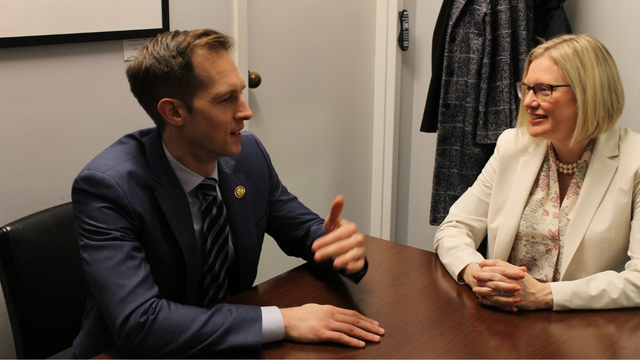
My guest at the State of the Union was Amanda Blount, the director of the Attleboro Literacy Center, which provides education to adults in greater Attleboro. In an era of widening inequity of opportunity, Amanda and her dedicated team of employees and volunteers are focused on giving my constituents in southeastern Massachusetts a chance to learn skills, see new horizons, and earn higher wages. It's about hard work, fair play, and the shot at a better life for you & your kids.
The Literacy Center gives this shot to new immigrants, as well, often starting with English tutoring. For example, community health and child-care are two in-demand vocations that the Literacy Center is helping to fill by training new arrivals to Massachusetts. In my conversations with these men and women learning our language, they have described how their increasing fluency gives them the confidence and capabilities to work and to advocate for their children.
I'm proud to host Amanda Blount and to support the work of the Attleboro Literacy Center, which every day helps close the gap between talent and opportunity. |
|
|
|
Question: What can be done to fight Trump's attacks on wind power?
- Mark from Newton
Answer: Litigation against this administration’s arbitrary and capricious actions is proving successful, but it’s slow and expensive, making developers far less willing to invest in offshore wind. The courts need back up from Congress. I am working to get the CERTAIN Act included in energy legislation:
The CERTAIN Act would address permit certainty—ensuring federal agencies handle project authorizations and environmental reviews fairly and efficiently, with clear timelines, notice requirements, and accountability. It also emphasizes coordinating between different agencies involved in these processes to avoid unnecessary delays. |
|
Onwards, |
|
|
|
Jake |
|
|
|
|
|
|

|
|