|
|
|
LAST TWO WEEKS IN REVIEW |
|
Good morning. I’m your Representative in Congress, and I write to keep you informed. |
|
|
|
| A war of choice led by a president without a plan |
|
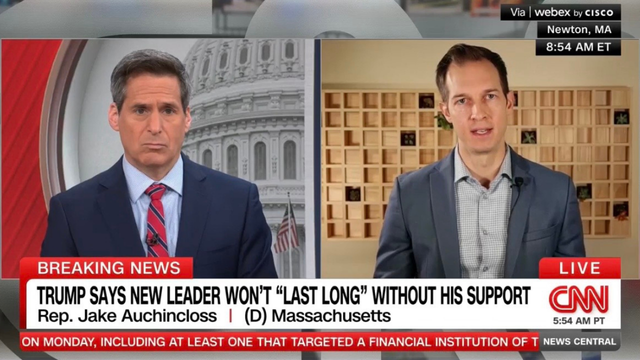
Operation Epic Fury is a war of choice without congressional authorization. Given his lies to the Iranian protestors about help on the way, his weakness in Ukraine, and his blood-for-oil scheme in Venezuela, this president has no credibility on either the strategy or law guiding foreign policy. Congress must reclaim its war powers and insist that military force against Iran be debated in plain view of the American people, not on Signal chats.
Many Americans in the MA-04 have personal ties to the affected nations, particularly Israel and Iran, and I have spoken to individuals in both diasporas. They hold conflicting emotions, simultaneously – hope & fear, boldness & exhaustion. They and their families abroad, as well as all citizens of this Republic, deserve sound and lawful strategy from Washington.
I voted Yes last week on the War Powers Resolution to end hostilities with Iran until & unless the president comes to Congress for an authorization. I am ready to work across the aisle to craft congressionally directed strategy on Iran, especially for securing American air supremacy in the region to defend our allies & interests against the Islamic Republic’s belligerence; ensuring freedom of navigation through the Strait of Hormuz; and supporting the Iranian people's right to self determination. But first, congressional Republicans must call the question on this fundamental issue of war powers by voting against a reckless commander-in-chief and for the Constitution.
Acting without oversight, the administration’s sophomoric strategy has created two problems:
- There’s a new Khamenei, and he’s worse than the old Khamenei
- The new Khamenei now has another ‘nuclear’ option, in addition to enriching the still at-large uranium: close the Strait of Hormuz for non-Chinese oil transit.
Before the president travels to Beijing in a weakened position at the end of this month, he should present for congressional approval a plan for ending this war of choice while preventing the regime from denying transit through the Strait of Hormuz, in violation of international law. Kharg Island, the export site for nearly all Iranian crude oil (much of which goes to China), may be one critical element of that plan. |
|
Do you support the president’s actions in Iran? |
|
|
| Promoting science & medicine, from National Parks to Alzheimer’s |
|
|
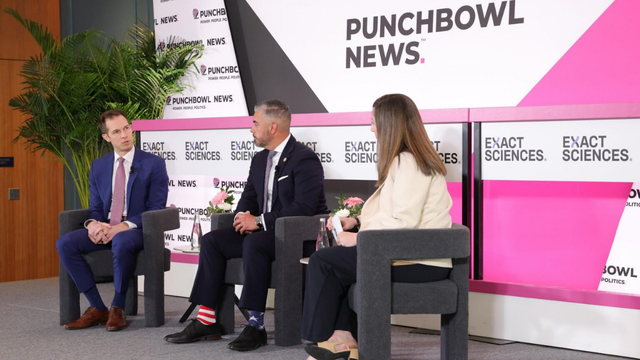
America versus Alzheimer’s: Congressman Juan Ciscomani, Republican of Arizona, and I discussed bipartisan efforts for biomedical R&D at a Punchbowl News event last week. We agreed on the imperative for Congress to increase funding for the NIH; to expand cancer screening through both regulatory and reimbursement changes; and to orient more investment & incentives towards Alzheimer's prevention & treatment. There have been wins on all these fronts during this Congress, which demonstrates how we can make progress even amidst intense partisanship.

CNBC’s rare disease summit: Former FDA Commissioner Scott Gottlieb & I addressed questions about rare disease discovery & regulation at the CNBC Cures summit. I emphasized that advocacy & policy should encompass personalized therapies, not just rare disease, when tackling the issue. Rare disease treatments are a subset of personalized therapies, which more expansively describes the future we want for our children, in which genetic conditions, dispositions to certain cancers, and mental illness can all be addressed with one-size-fits-one technology. mRNA is one example of that technology, which is why this FDA's hostility to mRNA vaccines & therapies is so self-defeating.
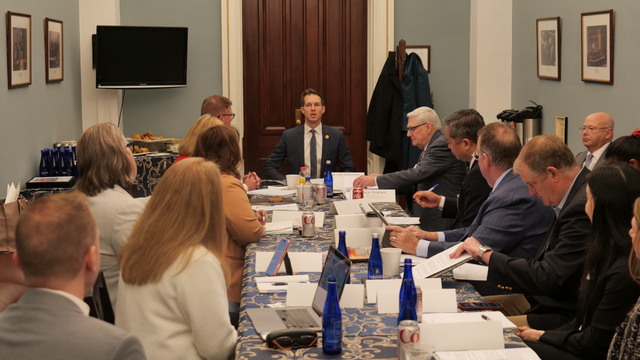
AI to lower health care costs: I spoke with Medical Alley, a network of healthcare organizations focused on innovation. We discussed the potential for AI to take out cost & improve quality in health delivery. Health premiums are going up by double-digits annually – radical change is necessary or else both family & federal budgets will buckle.
In conjunction with medical & consumer devices, telehealth, and hospital-at-home setups, AI can provide documentation-, diagnostic-, and decision-support for clinicians & patients. More & better care can be delivered outside of hospitals & inside homes. To achieve these cost & quality improvements, though, policy-makers will need to address issues of reimbursement & credentialing that sustain the status quo. The upcoming Medicaid 1115 waiver, in which Massachusetts will negotiate with Washington on MassHealth, is an opportunity for the Bay State to take the lead on this healthcare innovation.
Legislation to promote medical innovation: I also recently cosponsored three bipartisan bills focused on rewarding medicines with value, automating routine medical chemistry, and mapping the flora and fauna on public lands:
- The Medicaid VBPs for Patients (MVP) Act: This legislation would enable states to voluntarily enter value-based purchasing (VBP) agreements, which tie the cost of expensive treatments to patient outcomes. The science on cell and gene therapies has now outpaced the policy & payment models. That’s going to lead to frustration for patients with rare diseases, including children, who can see cures in the making but cannot access them. This bill helps ensure everyone can access cutting edge gene therapies. It also helps ensure that medicines with value are rewarded, while treatments that don’t work don’t add cost to the health system.
- The Cloud Labs to Advance Biotechnology (Cloud LAB) Act would strengthen America’s leadership at the intersection of artificial intelligence and biotechnology. The legislation directs the National Science Foundation to establish a national network of advanced, cloud-enabled laboratories capable of generating high-quality biological data through automated instrumentation. Automating routine medical chemistry can help speed up experiments. Many companies, including in Massachusetts, are working on this, and public investment would complement those corporate efforts. The goal is tighter feedback between ideas, experiments, and results.
- And the Living Library Act would direct the Secretary of the Interior to begin an initiative to collect, catalog, and sequence genomic information of animals, plants, fungi, and microbes on U.S. public lands. |
|
| Pressure works: Kristi Noem and Vinay Prasad out at Homeland & FDA |
|
|
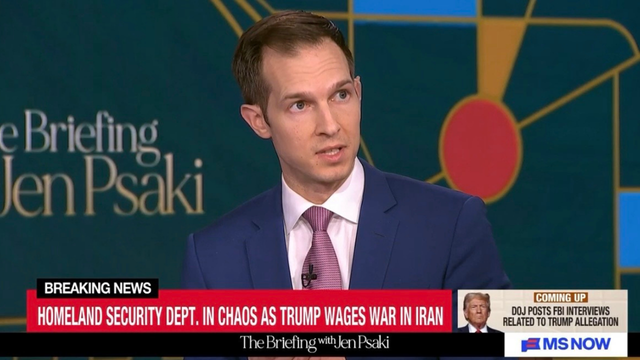
Noem out at Homeland, pressing for RFK Jr. next: Last week on MS NOW, I discussed Kristi Noem’s ouster as Secretary of Homeland Security. The fish rots from the head, and her leadership of ICE and other agencies has been cruel and corrupt. I have long called for her impeachment due to her abysmal conduct. Her departure is an important step forward in negotiations on Homeland Security appropriations and root-level reforms to ICE, but it alone is not sufficient. Democrats must continue to hold the line until policies on masking, warrants, and use of force change.
On the show, I suggested to the White House that if they’re in a firing kind of mood after Noem, RFK Jr. should be the next target. Measles & whooping cough are back; science is under siege; and the grifting is gross. RFK Jr. talks about chronic disease, but he and his henchmen have delivered corruption & quackery instead.
Dialing up the pressure: Top FDA official Vinay Prasad was fired last week, under pressure from me and others, after disclosing trade secret information without legal authorization. Prasad is gone but FDA Commissioner Marty Makary is still there. The commissioner is breaking the law, ignoring Congress, and undermining career scientists who protect public health. He needs to go too.
I sat down for an interview with U.S. News & World Report to discuss how the Commissioner’s National Priority Voucher (CNPV) program is a ‘poisoned chalice.’ I’ve included an excerpt of our conversation below, lightly edited for clarity:
Skepticism is growing on Capitol Hill about a new Food and Drug Administration program that aims to expedite the process for reviewing new drugs. The Commissioner’s National Priority Voucher program, introduced last year, has promised drugmakers expedited reviews of one to two months for new medicines that support “national interests.”
But Democratic Rep. Jake Auchincloss of Massachusetts, a member of the House subcommittee on health, says the program is motivated by prices and politics rather than science and is ultimately illegal.
Can you explain what the program is?
The program basically short-circuits the traditional review process, at the commissioner's say-so, to provide a subset of drugs accelerated review.
It's actually very hazy what exactly “accelerated” means, because when we dig into the actual process – and we've met with FDA staff about this – it's not actually that clear how much time they're actually taking out of the process.
This is very worrisome because what it seems to really imply is that what you're really getting is not so much time saved as a higher likelihood of a yes.
Where do your concerns lie?
The question is: Why would the commissioner dole out a higher likelihood of a yes? It really is the commissioner’s to dole out, because this review board is political people who report to him. They're not career scientists.
The reason he's doling out an increased probability of a yes is that it's tied to pricing. He is trying to score wins for the White House and the way he's doing that is by doling out approval cards. Then you get a call from the White House or the Centers for Medicare and Medicaid Services saying they want to launch a price deal.
The problem with that is that it's illegal. The FDA can't do that. The FDA has to evaluate drugs based on safety and efficacy – not on any consideration of price.
You sent FDA Commissioner Marty Makary two letters last year outlining your concerns with the program. Can you tell us about the first two and why you felt the need to send another?
Because they haven't responded. Over the course of these three letters, we've learned more and more from whistleblowers, from public reporting and from industry feedback.
What's plain is that, one, the program's illegal. It doesn't have congressional authority. Two, it is a political end run around career scientists. Three, that political end run is directly linked to political considerations in the White House.
What does Commissioner Makary or the FDA as a whole have to do going forward to ease the concerns of the healthcare industry and Capitol Hill when it comes to this program?
Commissioner Makary should resign. |
|
| How to put parents & students ahead of big tech in an era of digital dopamine & AI |
|
|
Putting parents in the driver's seat: Australia just banned social media for kids under 16. Congress is debating how to regulate the smartphone apps our own children spend five hours a day using. As a father of three young children who serves on the committee of jurisdiction in Congress, this debate is both personal and political. Social media corporations are attention-fracking our children. Parents deserve more power.
I recently wrote an op-ed in The Hill making the case for my bipartisan Parents Over Platforms Act, which was debated in the Energy & Commerce committee last week. Below are excerpts from that op-ed.
My bill gives parents that power. But Meta is lobbying hard against it. Mark Zuckerberg’s lobbyists are pushing, instead, for their own legislation that preempt stronger state laws and make any duty of care or liability impossible to enforce in court.
It’s parents versus Meta. At stake is who should be trusted to watch out for children online.
My view: Parents should be trusted. Congress must force Facebook and the other apps — Instagram, TikTok, Snapchat — to be liable for respecting what parents decide is appropriate for their kids. The Parents Over Platforms Act achieves that in three ways.
First, from a family account, a parent sets up the app store account for their child’s smartphone. Next, for the app store account, the parent sets an indicator for their child’s age range. This age signal includes no personal information. It only transmits the child’s broad age range.
From then on, apps that provide different experiences based on a user’s age are liable to abide by that age signal. For example, pornography and gambling apps are prohibited for users under 18. Social media apps would be blocked for users under 13 based on existing online privacy protection laws, which I’m trying to make a minimum of 16.
By contrast, Meta’s preferred bill puts the burden on families and lets apps forgo proactive protections for kids. Instead of sending one set-and-forget anonymous age signal like in my bill, parents and children would have to identify themselves for each app, each time it updates.
If this sounds unworkable, that’s the point. Meta is waging a false flag operation. It knows its federal bill will immediately be litigated on free speech and privacy grounds, which will slow down, demoralize and disorient genuine reformers.
My legislation is bipartisan, co-led by another parent, Rep. Erin Houchin, Republican of Indiana, who is fed up with the reckless arrogance of the social media corporations. The Parents Over Platforms Act is a critical piece of legislation for reclaiming power for parents. They deserve easy-to-use tools to safeguard their children against the merchants and miners of digital dopamine. By contrast, Meta’s preferred bill puts the burden on families and lets apps forgo proactive protections for kids.
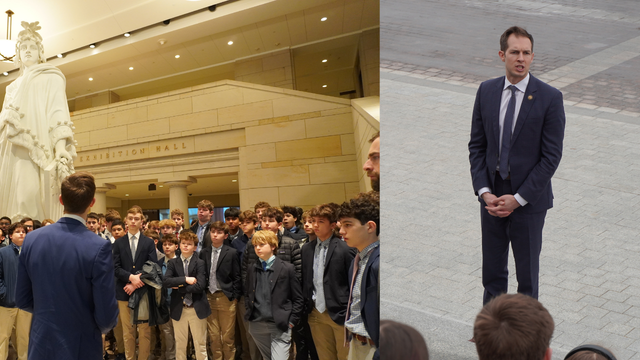
MA-04 students visit the Capitol: I spoke to high schoolers from Newton North & middle schoolers from Belmont Hill at the Capitol last week. It was especially meaningful to speak with kids at this political moment, because I was in and out of committee negotiations & markups on social media legislation. I got to intersperse debates over law & policy with conversations about day to day impact with the affected audience.
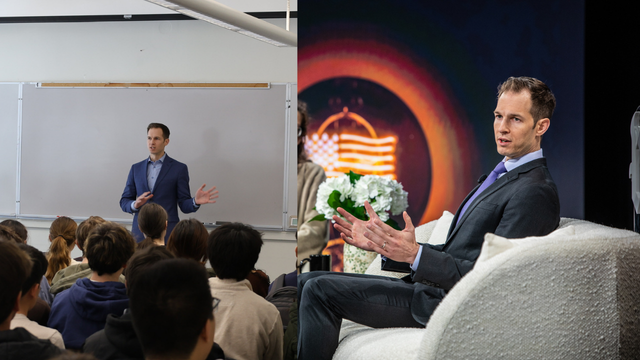
Education & social media: Over the course of a week, I was in two very different rooms, a student town hall at Brookline High School and a Q&A in the capital with the Washington Post. But I emphasized the same issues that are up for grabs in the public imagination: education & social media in an era of AI & digital dopamine.
Democrats must demonstrate that we will put parents over platforms, for example by raising the age of Internet adulthood to 16; that we will hold social media & AI bots accountable for addiction, deepfakes & torts; and that we will invest in & reinvent education, including with 1:1 human and agentic tutoring, after the catastrophic school closures. |
|
| A day in the district: DELL Technologies, students of all ages, and Mendon leaders |
|
|
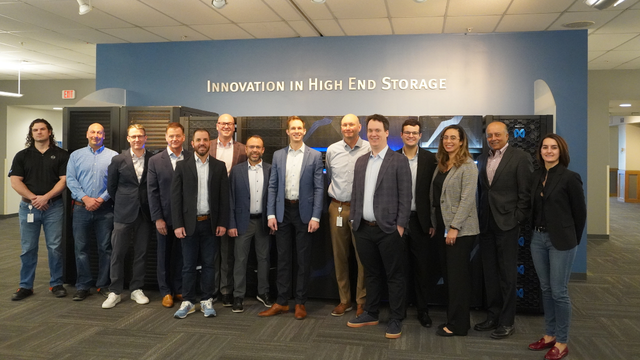
Touring DELL Technologies in Franklin: DELL Technologies has long run a factory in Franklin. It's producing high-end, custom-built AI servers & AI racks. Business is booming.
I visited to take questions from employees about congressional policy on energy & AI; to meet with local leadership of a major employer in the district; and to learn more about how the Massachusetts economy fits into the build-out of AI infrastructure. In data-centers as in other industries, the Bay State competes well for precision & specialty manufacturing & assembly, but our energy costs are a liability. Our grid needs more wind, solar, nuclear, geothermal, and batteries.

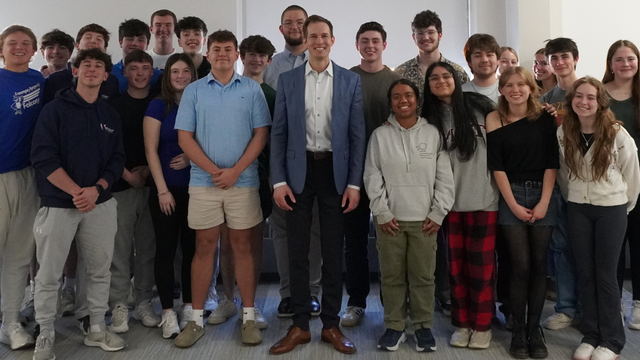
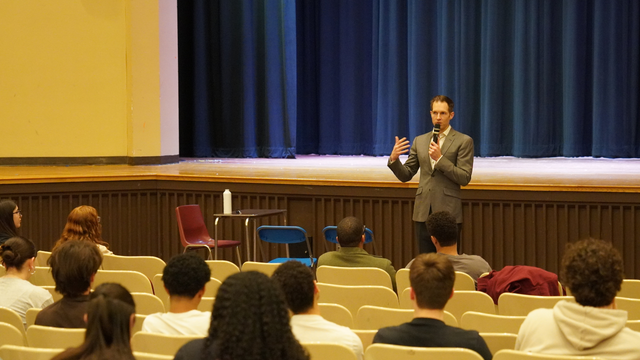
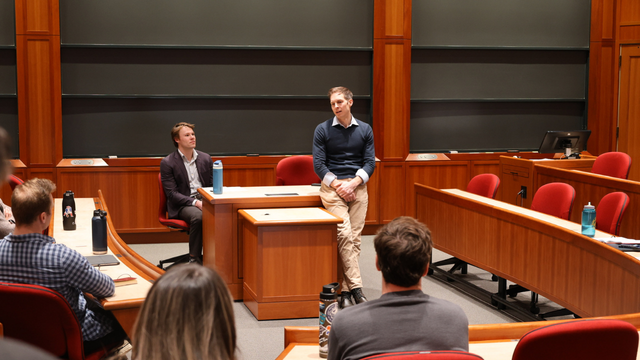
What’s top of mind for young people: I visited four schools in three days to discuss current events with students. Freeman-Kennedy Elementary School in Norfolk, King Philip Regional High School in Wrentham, and Milford High School all welcomed me for Q&A sessions with a few dozen students; I also went to Harvard Business School. From fifth graders to graduate students, common themes emerged from young Bay Staters:
- unease about the militarization of American policy. Students sense the connection between warrantless ICE raids and unauthorized strikes on Iran. They understand that checks on the commander-in-chief are out of balance
- sharp suggestions for how to regulate social media. I always ask for advice on what they want changed, and I wish more Members of Congress would listen to the answers: age requirements, screen-time limits, and shields from bots & strangers to name a few
- an appetite for optimism. Cynicism is unsatisfying. The students I talked to want to believe that politics isn't just performance, that policy can improve daily life, and that public service has a higher purpose. I tried to reinforce that!
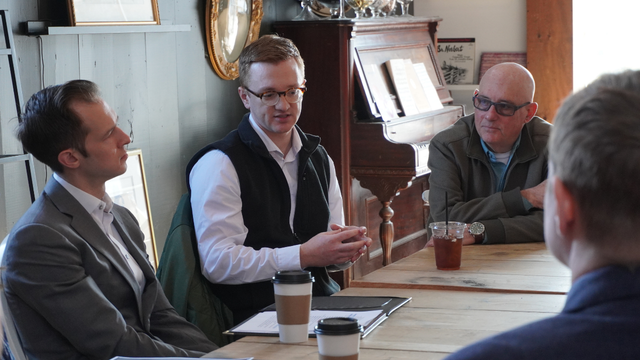
Funding for water infrastructure in Mendon: Mendon town officials & I met at the Blessing Barn Bookstore Cafe to review their priorities. The fire & police chiefs gave updates on public safety; as with many towns in the MA-4, they are getting more mental health calls and are benefiting from the integration of social workers with police officers. The town is working to expand its water system to support more commercial development, which I am helping to fund. I also support efforts to connect the Mendon water system to Hopedale's.
I'm grateful to our host, Compassion New England, which is a non-profit based in Mendon that provides aid to families in distress through monies raised at the Blessing Barn thrift store (which has a great selection). They employ individuals with intellectual disabilities as baristas at the adjacent coffee shop (which has great coffee), in addition to providing a social center for those individuals. |
|
| Security for the World Cup in Foxborough |
|
|
The town of Foxborough and the Kraft Group recently reached an agreement on funding for security details for the World Cup. I was engaged throughout the tense process and I appreciate that both parties arrived at a workable solution that does not put undue financial risk onto the town. I am now focused on supporting security coordination between federal, state, local, and stadium authorities. This is a top-tier event in a heightened threat environment, and collaboration will be key. |
|
|
|
Question: Could you share a recent example from the past three months where you reconsidered your stance on an issue after engaging in thoughtful conversations with constituents from your district?
- Veronika from Brookline
Answer: I’m hostile to the social media corporations, which I think treat our children like products. But I talk to lots of students, and I always ask them to tell me what I’m missing or getting wrong about their experience online. While they largely agree that the status quo is broken, they have helped me understand that teenagers today use the direct-message features on social media apps the way that my generation uses iMessage – as a way to have 1:1 or small-group chats. This type of trusted communication amongst IRL friends is different from anonymized, algorithmically driven feeds. Regulation around age limits should account for those two different experiences. |
|
Onwards, |
|
|
|
Jake |
|
|
|
|
|
|

|
|