|
|
|
LAST TWO WEEKS IN REVIEW |
|
Good morning. I’m your Representative in Congress, and I write to keep you informed. |
|
|
|
Commemorating the atrocities of October 7th
|
|
|
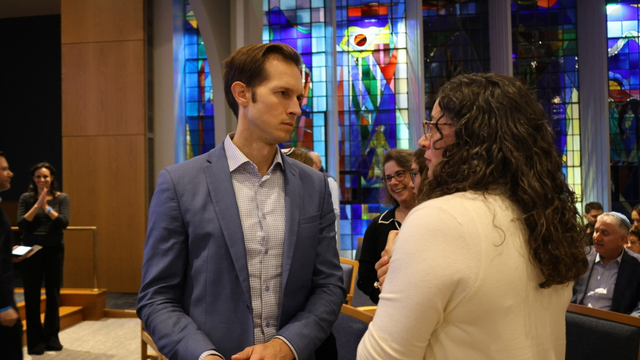

Eliya Cohen was held hostage in Hamas' terror tunnels for 505 days. He was chained, starved, and beaten. Every morning, he and his fellow captives prayed in Hebrew so that their captors would know that their Jewish spirit was unbroken. His girlfriend, Ziv Abud, was with him at the Nova Music Festival. She escaped a bomb shelter in which their family and friends were murdered by terrorists using grenades & guns.
Eliya & Ziv were honored guests at Temple Shalom in Newton on October 7th to share their story (he learned English from a book that Hersh Goldberg-Polin gave him to pass the time in the tunnels) in commemoration of the third anniversary of the Hamas attacks. I joined hundreds of others to bear witness, memorialize the thousands slain, and take inspiration from the indomitable spirit of Eliya and Ziv. Sustaining Americans' memory of October 7th is an homage for the victims, a tribute to the heroes, and a powerful way to strengthen the resolve of the Jewish community.
I also recently cosponsored the October 7th Anniversary Resolution in the House, which recognizes the third anniversary of the October 7th terrorist attacks, honors the victims and hostages, and calls for the complete disarmament of Hamas for a durable end to the war in Gaza. It also condemns the sharp rise in antisemitism in the U.S. and around the world following October 7th.
You can read the full resolution below:
Recognizing the third anniversary of the October 7, 2023, terrorist attacks on Israel, honoring the victims and the hostages, and calling for the complete disarmament of Hamas for a durable end to the war in Gaza.
Whereas, on October 7, 2023, Hamas violated an existing cease-fire, and with Palestinian Islamic Jihad, other terrorist groups, and Gaza civilians infiltrated Israel, invaded Israeli towns, launched thousands of rockets into Israel, brutally murdered, raped, and burned alive more than 1,200 individuals, took 251 hostages, including United States citizens and citizens of more than 40 countries, and destroyed and looted entire communities;
Whereas, on October 7, 2023, Hamas committed brutal acts of sexual violence, including gang rape and sexual mutilation, and the United Nations’ Special Representative of the Secretary General on Sexual Violence in Conflict found ‘‘clear and convincing information that sexual violence, including rape, sexualized torture, cruel, inhuman, and degrading treatment has been committed against hostages’’;
Whereas, for more than 2 years, the hostages endured brutal conditions underground while their families waged a tireless campaign for their release, and the war that Hamas started brought devastation across the region;
Whereas, in October 2025, following sustained diplomacy led by the United States and regional partners, Israel and Hamas reached a phased agreement that halted the fighting, increased the flow of humanitarian assistance, and set terms for bringing the war to a durable end;
Whereas, under the first phase of that agreement, all remaining living hostages were freed and reunited with loved ones, and the remains of those murdered were recovered and returned for proper burial;
Whereas the agreement requires the disarmament of Hamas, the dismantling of its military and tunnel infrastructure, and its exclusion from any future role in governing Gaza; and
Whereas the atrocities of October 7, 2023, were followed by a sharp rise in antisemitism in the United States and around the world, including violence, vandalism, and harassment directed at Jewish communities: Now, therefore, be it
Resolved, That the House of Representatives—
(1) marks the third anniversary of the October 7, 2023, terrorist attacks and honors the memory of every person murdered by Hamas and its accomplices;
(2) condemns the atrocities committed by Hamas on October 7, 2023, the deadliest day for the
Jewish people since the Holocaust;
(3) honors the hostages and their families, and welcomes the return of all remaining hostages, including the United States citizens, held in Gaza;
(4) supports Israel’s right to self-defense and long-term security, a durable cease-fire and full implementation of the framework to end the war including Hamas disarmament, an increase in humanitarian assistance and reconstruction efforts for Gazans, and future governance in Gaza without Hamas; and
(5) strongly condemns and denounces the rise of antisemitism globally and domestically, including in K–12 schools and on college campuses, following the October 7, 2023, attacks and commits to confronting and combating this hatred in all its forms. |
|
Diesel at $6.30/gal: addressing the energy impacts of the Iran war
|
|
|
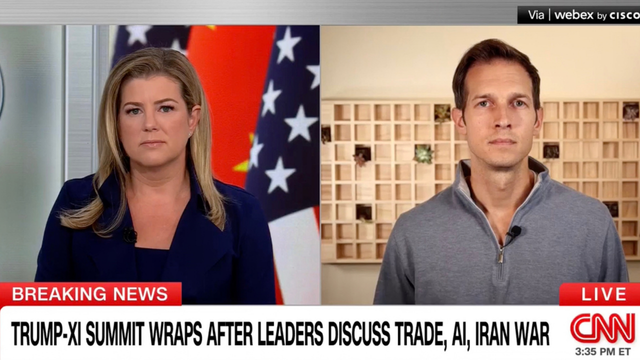
This week, the president announced oil-export relief for Vladimir Putin. Last month, President Trump rolled out a red carpet for Chinese leader Xi Jinping in Washington. The Administration bowed to these two dictators because the price of diesel has allowed our adversaries to turn the president’s ‘America First’ foreign policy to their advantage.
I discussed recently on CNN:
CNN: The President was asked about Chinese entities sharing satellite images of U.S. bases with Iran, and Trump said: "When they say that China spies on us, I say we spy on them too." What message is he sending to China when he says that?
Rep. Jake Auchincloss: Weakness. He sent the same message to Vladimir Putin and Xi Jinping, which was one of appeasement and weakness. We have to wind this clock back by a year. Last year, Donald Trump waged a trade war against China. He lost it because China exercised chokepoint control over critical minerals, and Donald Trump had to pull back. In 2026, Donald Trump launched a hot war against Iran and lost it because Iran exercised chokepoint control over the Strait of Hormuz. Now, the U.S. president is very weak, and in this weakened position, he is welcoming Xi Jinping, who holds the whip hand over the price of diesel here in the United States. This president is ceding our energy sovereignty to America's pacing adversary in the 21st century, and he's doing so while having the U.S. Navy do a celebratory flyover. I think Americans should be asking themselves what the heck this state visit accomplished for them and for their cost of living.
Wintertime utility assistance: I also recently signed onto a letter urging Department of Health and Human Services (HHS) Secretary Robert F. Kennedy, Jr. to release Low Income Home Energy Assistance Program (LIHEAP) funds on time this year, no later than November 1st, 2026. The letter raises concerns about how expensive crude oil is, how that can impact energy prices, and how a delay in LIHEAP will harm households that struggle to afford their energy bills, especially homes that rely on home heating oil. |
|
‘Street votes’ & new towns: hyperlocal approaches to more housing near jobs
|
|
|

Late last month I spoke at Newton for Everyone’s forum on housing. A typical house in Massachusetts costs twice as much as the national average, and young residents who can’t afford to start a family here are leaving because of it. You can read about some of my remarks on how to address the housing shortage in Fig City News’ coverage below:
“Americans have conflicting views of housing, said Congressman Jake Auchincloss; they expect it to be both an asset for building wealth (with growing value) and also a widely available, affordable commodity with stable pricing. 'We need attainable middle-class homeownership,' he said. Massachusetts is pricing-out the middle class and creating a generational divide among Democrats. The average first-time homebuyer is now 42, up from 29 in 1981 and 33 in 2021. He suggested people could focus on investments beyond housing to build wealth.
Congressman Auchincloss suggested hyper-local zoning as a way to support new housing development. It empowers neighbors on a street or even a single block to agree on zoning specific to their own immediate area. John Myers, who runs the YIMBY Alliance in London, has said that with hyper-local zoning, 'votes by street or by block would give residents a way to negotiate to share the benefits of new development and ensure that it will suit them.' London, Houston, and Japan are used as examples of increased housing through hyper-local zoning.
Congressman Auchincloss said Massachusetts needs modular housing, and it needs to be manufactured in-state to bring down costs. He suggested manufacturing and developing modular housing on unused military bases and said the Metropolitan Area Planning Council is looking into this.” |
|
Do you support hyper-local zoning reform? |
|
|
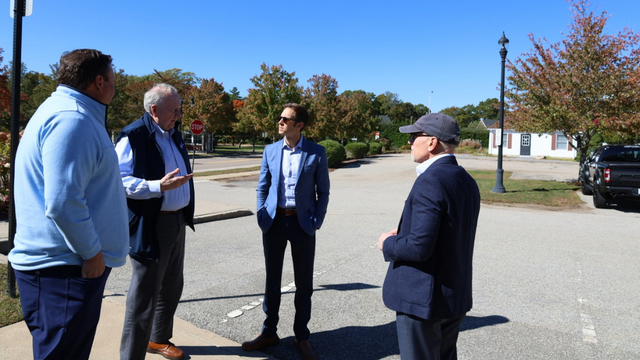
Speaking of unused military bases – South Weymouth Naval Air Station was established during WWII as the Navy's northeastern-most station for airship operations and research. Massive blimps surveilled the waters for German submarines. In 1995, the base was closed. The state and host communities Weymouth, Rockland and Abington then grappled with three failed developers over 25 years.
Finally, right before the pandemic, the fourth (and hopefully final) master developer took over. I visited the site, now called Union Point, to see the progress. It's impressive: financial & legal clean-up, land assembly & zoning permits, and infrastructure approved & funded. Shovels will soon go in the ground for 6,000 new homes, a walkable downtown, large commercial properties, new roads, and walking & biking paths to complement the hundreds of acres of preserved green space and recreation areas.
While Union Point is not in the district, I visited because it's the most ambitious single project in the commonwealth for solving our biggest economic challenge: the price of housing. I have written and spoken frequently about how developing new towns can improve both affordability and productivity, so I was fascinated to learn about this development up close. Most critical for its success will be water; Union Point needs an MWRA extension to provide millions of gallons.
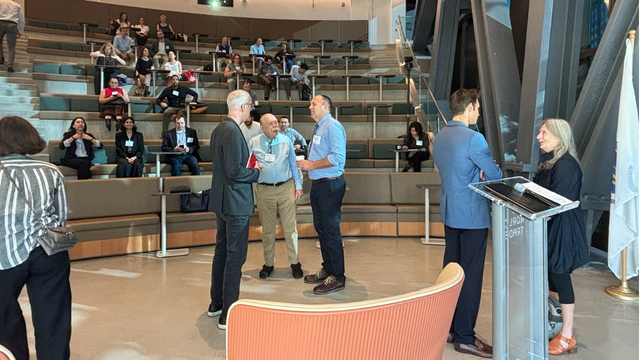
Congress for the New Urbanism invited me to address their New England summit. What an honor to speak to an audience that includes Jeff Speck, whose book Walkable City has been a major influence on me.
I spoke about how Democrats should adopt localism as a defining theme of our platform — not just a tool of resistance to MAGA when we’re out of power, but an instrument of better housing & mobility policy, through measures like Street Votes for zoning and by devolving the federal Department of Transportation to the states.
|
|
| Amending the Farm Bill: Agricultural conservation & habitat preservation |
|
|

The Trustees of Reservations is the largest agricultural land holder in the state. I visited Powisset Farm in Dover to meet with their leadership & Board to discuss the Farm Bill. The Republican Farm Bill from this term, which cuts $187B from food stamps and $1B from the Environmental Quality Incentives Program, is unlikely to pass. Next term, if Democrats have control over one or both chambers, we will need to amend the legislation. The Trustees gave me insight into good agricultural conservation and habitat preservation policies in this term's proposed Farm Bill that should be included next term, too.
I also got to tour Powisset Farm and learn about its programming for children in farming & cooking; the R&D it does for organic and polyculture farming, and its community-supported agriculture model in which 330+ families have shares in its harvest.
|
|
New bills: better medicines, lower co-pays
|
|
|
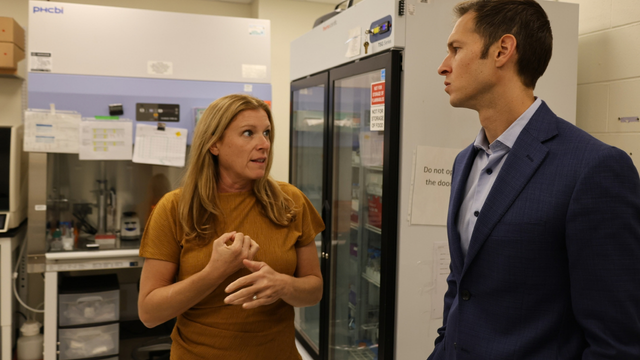
Speaking with researchers at UMass Chan Medical School last month
Massachusetts is the global leader in biotech, which is a federally regulated industry. Federal policy therefore has a big impact on the Massachusetts economy. That is why I recently cosponsored five bills to strengthen the American bioeconomy from the classroom to the factory floor.
Together, these bills would expand biotechnology education for high school students; identify biotechnology workforce needs and staffing gaps across the federal government; establish common measurement standards for biotechnology and biomanufacturing; and build facilities where innovators can scale breakthroughs from the lab into commercial-scale production. One bill would also clarify the rules governing biosimilars and Medicare drug-price negotiations, supporting competition from lower-cost alternatives.
America leads in biotechnology, but that leadership must be earned. We need to invest in talent, infrastructure, standards, and competition. These bills would help harness cutting-edge science into better health & sustained U.S. leadership in the global bioeconomy.
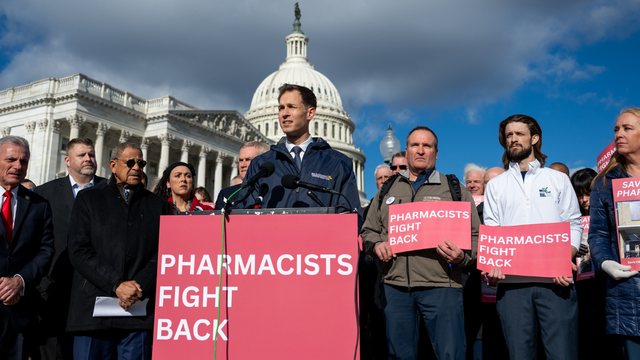
Introducing the Pharmacists Fight Back Act, my original legislation to take on Pharmacy Benefit Managers, in 2025
Bipartisan bill for greater drug-pricing transparency: Americans pay too much in co-pays for prescription drugs because the current drug-pricing system rewards opacity and allows Pharmacy Benefit Managers (PBMs) – the powerful middlemen of drug pricing – to profit from higher list prices. PBMs drive up drug costs, gouge community pharmacists, and limit patient choice in federal health care plans. I am working to bring transparency and competition to this broken market by exposing the true costs, rebates, and payments throughout the drug-pricing supply chain so that savings flow to patients instead of middlemen.
That is why I recently co-led the Net Effective Cost Transparency and Prescription Drug Affordability Act of 2026, which would require Medicare Part D plans to conduct a standardized annual bidding process for PBM services, making procurement more transparent and competitive so that flat-fee PBMs have a stronger chance of winning contracts. I also co-led a pair of letters to the Centers for Medicare & Medicaid Services (CMS) urging greater transparency and oversight of practices that could be inflating drug prices and limiting patient access to care.
Patients, community pharmacies, and taxpayers have been forced to shoulder the burden of rising drug prices at the hands of PBMs. They shouldn’t have to. |
|
In Hopedale & Blackstone: working with state & local Republicans on jobs & infrastructure efforts
|
|
|

The shipping company Maersk opened a massive fulfillment center in Hopedale. This warehouse – the size of multiple football fields – will be a distribution hub for the northeastern United States & support high-volume fulfillment operations, employing approximately 1,000 people when fully running. I toured the warehouse and met with its leadership to learn more about this major new employer in the district and establish lines of communication.
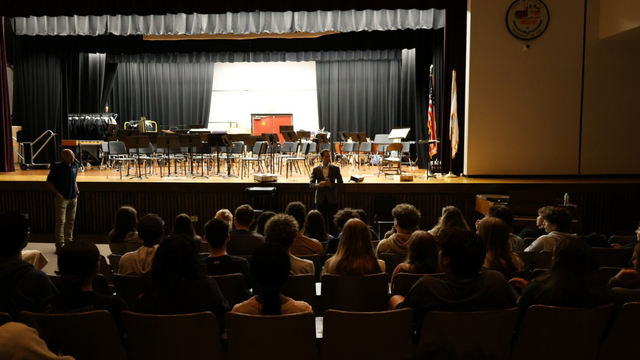
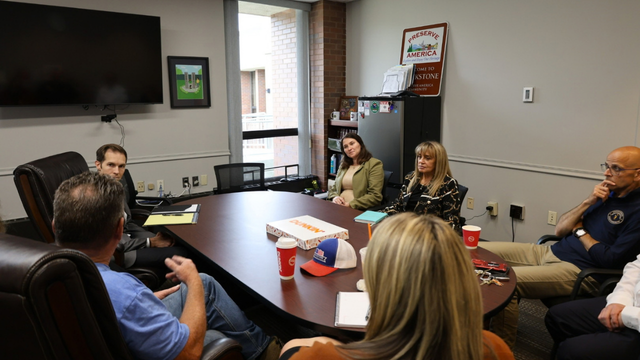
State Representative Mike Soter (R) and I spent the afternoon in Blackstone together. First we spoke to high-schoolers at Blackstone-Millville Regional, then we met with local officials to discuss public safety & infrastructure priorities that federal & state funding can support. Partisanship is fierce in Washington, but inside the MA-4 I work closely with Republican state & local officials to deliver for our shared constituents. Rep. Soter & I debated & discussed national & state policies in our Q&A with the high schoolers, then went over to town hall to work on local issues together. |
|
|
|
Question: How do you eliminate the Iranian regime’s export of hatred, terrorism & destruction for generations (not just a few years) while adhering to Democratic Party principles and not appearing to condone the way we got into this mess?
- Richard from Wrentham
Answer: The Islamic Republic of Iran has spent nearly five decades exporting terrorism, destabilizing the Middle East, and repressing its own people. The United States and its allies have to contain that threat without waging new wars in the Middle East.
That strategy might include:
(1) Maintaining air dominance over Iran, which was achieved in 2025, to prevent imminent nuclear acquisition
(2) strengthening the Abraham Accords militarily and economically, while not allowing the Mecca Pact to undermine it, so that Middle Eastern allies can better work together and defend themselves
(3) Countering the China-Iran-Russia petro- & techno- alliance, which keeps Iran afloat, with a deepened India - Middle East - Europe Economic Corridor (IMEC), which could reduce the criticality of the Strait of Hormuz
(4) Investing in civil organizing & Internet freedom within Iran, to slowly enable more moderate forces to counter the Iranian Revolutionary Guard Corps
(5) Vesting Iran foreign policy in stable, bipartisan congressional consensus (as happened with the Good Friday Agreement, Taiwan, and NATO) rather than in the shifting calculus of any given administration
You can submit a question for a future newsletter here. Please note that casework inquiries for federal agencies must be submitted to my website here. My casework team will respond to these in a timely manner. |
|
Onwards, |
|
|
|
Jake |
|
|
|
|
|
|

|
|