|
News from Representative Bentz
|
|
|
Dear Friend,
This finishes up another week of legislative business in Washington, D.C. Below you will find some of the interesting things that are happening and have happened. If you would like to see daily updates on my work in Washington D.C. and Oregon's Second District, please follow us on Facebook HERE! |
|
|
|
|
|
|
|
|
|
|
|
|
|
|
|
|
|
|
|
|
|
|
|
|
|
|
|
|
|
|
|
|
|
|
|
Remarks from Congressman Bentz
What some have called “America’s long nap” is over. Americans voted for change and that is exactly what is happening. Change is most clearly obvious in Presidents Trump’s executive orders, but it’s also found in his efforts to bring additional accountability to our vast federal workforce and to slow the explosive growth of government.
The President is intentionally pushing the envelope of executive power, so it’s predictable that many of his orders will be challenged in court. But he is doing exactly what he said he would do- and that is to bring about immediate change.
Meanwhile, the House is facing serious challenges. The Budget Resolution necessary for Reconciliation must be passed; keeping the government open is once again upon us; two fiscal years of government appropriations must be completed; the Reconciliation bill must be finalized and passed: and the debt ceiling must be addressed. And all of this is scheduled to be dealt with within the next four months. Stay tuned.
|
|
A Blizzard of Executive Orders.
In the past three weeks, the President has issued 48 executive orders, each of which will have an impact upon the nation. Many people have called my office, upset with some or all of these orders. We are reviewing each order and evaluating their impact on Oregon Congressional District 2. As we determine how they affect us, we will be reacting to them. Many are obviously helpful and welcome. Others may have consequences to us that were unforeseen by the Executive Branch. If they are damaging, we will reach out to the White House and share our concerns. It needs to be clear that I support the President’s efforts to reverse damaging policies of the Biden Administration, and his efforts to protect our country. But as his staff has told us, we need to let him know if his orders need to be more carefully drafted.
As to President Trump’s efforts (and our efforts in the House) to slow spending, I am reminded of President Reagan’s observation that: “The closest thing to eternal life on earth is a Government Program.” He knew that slowing government spending by discontinuing any program is really, really, difficult. Why? The first reason is because most of these agencies are doing some sort of good thing. Why would anyone want that to stop? The second reason is because every government agency has its own life support system of members of the Democrat Party, employees, unions, lobbyists, subcontractors, NGO’s, and of course, those people the program is supposed to help. When an Agency faces budget cuts in Congress, these support groups immediately swing into action doing all they can to keep Congress from cutting their agency’s budget. Mass meetings with Republican congressmen, organizing phone calls to Congress from constituents, veiled and not so veiled threats of finding others to run against the member, letters to the editor, editorials, emails, tweets, and every other means of persuasion imaginable are brought into play. Liberal groups attack by saying that Republicans are unfeeling cretins interested only in reducing taxes. Fact based assertions are rare, but passionate pleas against cuts and for increases abound. Totally ignored is the disastrous fact that we are spending, each year, 30% more than we take in. This amounts to annual additional borrowing of about 2.4 trillion. Obviously, as has been said, “when something can no longer go on it will stop” and this is exactly what will happen, very abruptly and with great damage, if the President and we fail to reduce spending. |
|
Courts Allow Wolves to Continue to Kill Livestock
Last week 3 calves in the Valley Falls area (22 miles north of Lakeview) were confirmed killed, 2 more calves dead but unconfirmed, and several calves missing all attributed to collared grey wolf #158. Immediately upon hearing about this our office reached out to the Lake County commissioners and federal agencies are now on the ground in the area doing what they are allowed to do to drive the wolf away.
It might well be asked why in the world is the wolf still on the endangered species list. Here are the facts: The U.S. Fish and Wildlife Service has determined that the grey wolf is not endangered and that it should be removed from the endangered species list. This determination was appealed by the Center for Biological Diversity, Defenders of Wildlife, the Humane Society of the United States, the Sierra Club, National Parks Conservation Association and Oregon Wild. Federal Judge Jeffrey White of the Northern District of California reversed the USF&W rule deciding that the Service had failed to provide a reasonable interpretation of the “significant portion of its range” standard. Thus, because of the involvement of these NGO’s, the wolf remains on the list even though it has been said by Agency employees that we have enough wolves in the United States to last for at least 100 years.
So who or what is to blame for the fact that the wolf remains on the endangered list even though it is not, thus preventing us from controlling (killing) wolves that destroy thousands of dollars of rancher’s livestock, and significantly drive down the pregnancy rate of the mother cows in herds exposed to wolves?
The correct answer is the tax code. Under current tax law, any taxpaying organization such as a bank or Walmart, or Amazon, or Google, or Costco or any individual, can donate money to any of the Environmental organizations who joined in the lawsuit and take a tax deduction in the amount of the donation. The money goes into the organization tax free, and it then is either added to the money to the organization’s endowment or the organization uses it for the purpose of paying expenses, such as the amounts due lawyers hired to sue agencies like USF&W. For the reader’s information, attached is a summary of the amounts raised annually and currently held in endowments of some of the environmental groups set forth above. Some might blame the Judge, but he was simply using the analysis of the attorneys hired by the NGO’s. If we want to stop this from happening, it probably makes sense to ask the Ways and Means Committee here in Congress to look at some of these changes in the law: taxing endowments; adjusting the deductibility of donations to organizations like the above; or reducing the availability of the Access to Justice act reimbursement in certain instances.
In the meantime, we are checking to see if the Trump administration will pursue an appeal of Judge Jeffery White’s decision. |
|
Some of This Week's Legislation in Washington
.png "Add_a_heading_(10).png")
Ballot Measure 110 was passed in Oregon in November of 2020. It basically operated to make hard drug use legal. This law resulted in hundreds of overdoses and hundreds of deaths. The number of unintentional overdose deaths related to illicitly manufactured fentanyl has increased from 223 in 2022 to 1416 in 2023. The “recriminalization” of Possession in 2024 has done little to slow the use of such drugs.
Of course, thankfully, not all drug use results in death, but between February 5, 2023, and February 4, 2024, Oregon’s rate of nonfatal overdose was more than 200% above the national average, with Multnomah County having the highest rate of nonfatal overdoses in the nation. In addition to deaths and emergency department visits, homelessness and shoplifting increased in Portland, Oregon, after Measure 110 went into effect. Portland police reported in 2023 that open-air drug dealing was "at an all-time high." Between 2020 and 2022, federal data reported that homelessness across Oregon rose 22.5%, and Portland's shoplifting rates were up 22% in the first six months of 2023 compared to the same period in 2019.
This sad state of affairs has been at least partially addressed this week, by the passage of H.R. 467, the Halt All Lethal Trafficking of Fentanyl Act or the HALT Fentanyl Act. This legislation would make the currently temporary Schedule I category for fentanyl, or anything mixed with it, permanent. It would supply law enforcement with the tools needed to keep these dangerous drugs off the streets. And it would support research efforts to understand the effects of fentanyl-related substances on people's health. |
|
The Energy and Commerce Committee Subcommittee on Health
Last week, the Energy and Commerce Committee’s Subcommittee on Health, on which Congressman Bentz sits, held a critical hearing titled “Combatting Existing and Emerging Illicit Drug Threats.”
As discussed above, illicit fentanyl and fentanyl-related substances represent the deadliest drug crisis in American history. This hearing provided an important opportunity to examine the evolving landscape of illicit drugs and to discuss solutions to combat the ongoing epidemic while preventing new, dangerous substances from infiltrating our communities.
One of the many good things about being a member of the Energy and Commerce Committee, and more particularly its subcommittee on Health, is that I get to participate in questioning when we have a hearing such as this one on Illicit drugs. Framing and then asking the right questions gives me the opportunity to call out the ridiculousness of such things as Measure 110 and the abject failure of Oregon’s progressive left Democrats to protect and care for Oregon citizens.
Watch my line of questioning here. |
|
The Energy and Commerce Committee
.png "Add_a_heading_(11).png")
As mentioned above, I am now a Member of the Energy and Commerce Committee. I no longer serve on the Judiciary Committee. (I am also still a member of the Natural Resources Committee.)
I have been appointed to serve on three subcommittees of the House Committee on Energy and Commerce: The Subcommittee on Energy, the Subcommittee on Health and the Subcommittee on Commerce, Manufacturing and Trade. These subcommittees will play a key role in shaping the upcoming Reconciliation bill and will deal with legislation addressing our nation’s energy policies, healthcare systems and economic activity.
This week, the Energy and Commerce Committee held a critical hearing titled “Powering America’s Future: Unleashing American Energy.” Our discussion focused on the importance of expanding domestic energy production and infrastructure which is important in strengthening our national security, reducing costs for American families, and driving economic growth, specifically in manufacturing and information technology.
During the hearing I spoke to Amanda Eversole, Executive Vice President and Chief Advocacy Officer at the American Petroleum Institute. I asked, “are we maintaining U.S. oil refinery capacity?” Her response: “There has not been a new refinery built since 1970 due to the permitting process.” I followed up: “What should be done to fix this?”—and as expected, she pointed to the need for legal, court, and NEPA (National Environmental Policy Act) reforms.
I also asked her about Oregon’s Liberal Left and the Biden administration’s attack on fossil fuel use in diesel trucks and the damage this is doing. Specifically, I focused on the Oregon ban on the sale of diesel trucks and how we might be able to stop this attempt to drive up costs for everyone shipping anything with a truck. Her answers focused on the waiver that the EPA had given California that resulted in California’s (and Oregon’s) ban on diesel. President Trump is in the process of reversing this rule, and we will follow in Congress. At least there is now some hope that we can reverse these foolish, silly and terribly damaging policies that are driving costs through the roof while destroying our freight delivery industry.
Watch the full clip of my questions in the hearing here. |
|
|
|
| Meetings in Washington, D.C. |
|
|
.jpg) Pulp & Paperworkers Resource Council Pulp & Paperworkers Resource Council
Congressman Cliff Bentz met with the Pulp and Paperworkers Resource Council, to discuss the challenges in pulp and paper production, the importance of responsible forest management and the need to modernize the Endangered Species Act.
|
|
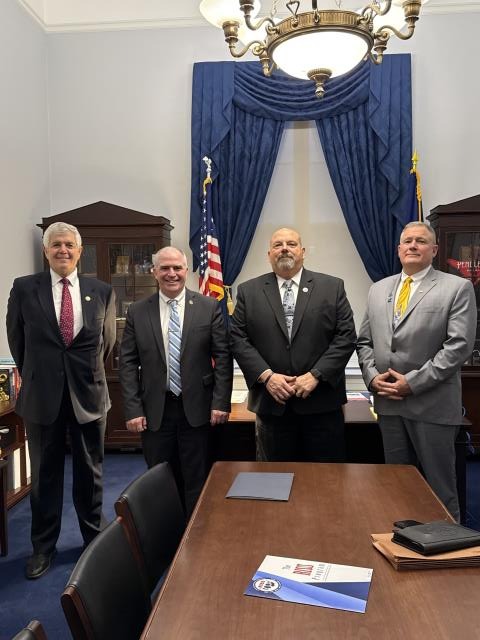
Oregon Idaho HIDTA (High Intensity Drug Trafficking Areas)
Congressman Cliff Bentz met with the Oregon Idaho HIDTA to discuss importance of combating the drug threat—particularly fentanyl—and the outlook for Oregon’s law enforcement efforts. |
|
.jpg)
Community Anti-Drug Coalition of America (CADCA)
Congressman Cliff Bentz met with the Community Anti-Drug Coalition of America to discuss strategies for preventing the use of illegal drugs, alcohol, and other harmful substances.
|
|
|
|
|
Sincerely,
Cliff Bentz
Member of Congress
It is the honor of a lifetime to represent you in Congress. Should you need to contact me or my staff, please do not hesitate to do so. You can visit my website here.
Don't forget to follow me on Twitter, Facebook, Instagram, and YouTube!
|
|
|
|
|
|
|
|
|
|
| |
| Unsubscribe |
|