|
News from Representative Bentz
|
|
|
Farming businesses are economically upside down. Farm businesses, essential to every American, are being crushed by skyrocketing diesel, fertilizer, labor, equipment, and operating loan prices. Unfortunately for farmers and indirectly for us, rock bottom prices for commodities such as onions, potatoes, wheat, cherries, grapes, beans, and soybeans, to name a few, fall far short of anything close to costs of production.
Why are the sale values of commodities such as these so low? Because tons upon tons of farm product imports, bad tax policy, subsidization of farm production in foreign countries, and increased volume of production here in the United States all combine to drive prices down. What follows is a summary of what we are doing in Congress to address these issues.
|
|
|
|
|
Farm Bill
For the past 3 years, the House Committee on Agriculture has been working toward the reauthorization of the Farm Bill. This bill is supposed to be a five-year bill, but it was last passed back in 2018. It has been extended several times and will expire in September of this year. Last summer, the Chairman of the Agriculture Committee, GT Thompson (R- Pa.), successfully inserted into the “Big Beautiful Bill” provisions that normally would have been included in a Farm Bill. These provisions included commodity and farm safety net programs (Price Loss Coverage (PLC), Agricultural Risk Coverage (ARC), expanded crop insurance opportunities, and nutrition changes to the SNAP program. The nature of the process used to pass the “Big Beautiful Bill" did not allow other important farm bill provisions to be included, so these are now in what is being referred to as the “Farm Bill Lite”. This isn’t just a "farming" bill; it also addresses food security, management of our federal forests, and a long list of other important issues. |
|
Why We need the Farm Bill Now
Agriculture is a risk laden business. Years ago Congress realized that dramatic market ups and downs in the farming business had to be addressed, or the nation’s food supply could fall short, resulting in famine and even civil unrest. As an answer to this unpredictability, Congress developed the five year farm bill, containing risk off-setting programs which in essence create risk sharing as a means of reducing unpredictability of food production. Our farmers and ranchers deserve the certainty of a long-term, five-year authorization. The risks facing our agricultural community, and all consumers, have not gone away. The "safety nets” of crop insurance and disaster assistance remain essential to our system of food production. |
|
What's in it for Oregon?
For Oregon’s Second District, the Farm Bill is foundational to farming and timber operations. Several of the key provisions in the bill are:
- Enhanced Crop Insurance: Strengthening the tools that protect our family farms from catastrophic loss.
- Forest Management: Extending authorities that allow us to thin, overgrown forests and reduce the risk of the devastating wildfires that plague our region.
- Water Infrastructure: funding for irrigation modernization, improving the efficient use of water.
|
|
|
Boosting Our Specialty Crops: Potatoes, Onions, and Beyond
Potatoes, onions, beans, cherries, grapes, sugar beets, alfalfa and more are important crops in Oregon’s Second Congressional District. The current draft of the farm bill includes upgrades to the Specialty Crop Block Grant Program and the Specialty Crop Research Initiative (SCRI) that will help producers:
- Trade and Market Access: The bill addresses long-standing trade barriers by requiring a formal report to Congress on foreign restrictions. This is a critical step in opening key international markets—such as Japan—to fresh Oregon produce. Additionally, the bill strengthens the Technical Assistance for Specialty Crops (TASC) program to help our growers navigate complex export regulations.
- Automation and Mechanization: To combat rising labor costs, the bill establishes a new Specialty Crop Mechanization and Automation Research and Extension Program. This initiative provides $30 million annually to develop technologies that help specialty crop operations remain competitive and efficient.
- Direct Producer Input: The bill mandates a new "Stakeholder Consultation" process for Specialty Crop Block Grants. This requires that program administrators consult with local producers and commissions when setting funding priorities, putting decision-making power back in the hands of the people growing the crops.
- Cold-Chain Infrastructure: By incorporating the FRIDGE Act, the bill provides resources to improve cold-storage and transportation infrastructure. This is essential for maintaining the quality of Oregon’s perishable specialty crops as they move from our fields to global dinner tables.
- Precision Agriculture Research: The bill expands the SCRI to focus on soil health and water efficiency. For our region, this means more federal research dollars dedicated to the technologies important for the long-term survival of Eastern, Northern, and Southern Oregon agricultural sectors.
|
|
|
|
|
|
|
|
|
|
|
|
|
|
|
|
|
|
|
|
|
|
|
|
|
|
|
|
|
|
|
|
|
Where We Stand: The House Vote and the Politics
Currently, the House Committee on Agriculture has moved the bill out of committee and it is awaiting a full House vote. However, the path to passage is fraught.
The primary political hurdle remains the balance between nutrition spending and production agriculture. While the SNAP (Food Stamps) program is a critical component, it is not supported in its current form by many who think that it is too generous. Others believe that it is just the opposite. We are also navigating a tight fiscal environment where every dollar must be justified. My message to leadership is clear: We cannot balance the budget by increasing the risk of food shortages and farm bankruptcies.
What is in the "One Big Beautiful Bill" (“BBB”) that helps farmers and timber operations? Last summer, when the BBB was passed, much of the national conversation focused on its broader economic impacts. But as indicated above, several provisions specifically helped farmers, ranchers, and rural communities:
- Agricultural Tax Relief: The OBBB significantly increased the small business equipment deduction (Section 179) from $1 million to $2.5 million, allowing our producers to invest in the machinery they need to stay competitive. It also raised the inheritance tax exemption to $15 million, a provision that will help family farms stay in the family without being liquidated to pay federal death taxes.
- Modernized Crop Insurance & Reference Prices: The Act provided a $65 billion boost to the agricultural safety net, including an immediate increase in statutory reference prices for commodities like wheat (rising from $5.50 to $6.35 per bushel). This provides a much-needed buffer against market volatility.
- Conservation Funding: The OBBB protected and stabilized $18.5 billion for the Environmental Quality Incentives Program (EQIP) and $8.1 billion for the Conservation Stewardship Program (CSP). These voluntary, incentive-based programs help our ranchers implement best practices for soil health and water conservation.
- SNAP & Medicaid Integrity: The bill introduced common-sense reforms to federal assistance programs, focusing on "work-ready" requirements for able-bodied adults and requiring states to perform more frequent eligibility checks. These changes ensure that resources are preserved for seniors, individuals with disabilities, and low-income families who truly need them.
- Wildfire Risk Reduction: By providing new pathways for increased timber harvests on federal lands, the OBBB is already helping us reduce the fuel loads that lead to catastrophic wildfires, while simultaneously creating jobs in our timber-dependent counties.
|
|
|
Input Costs, Tariffs, and My Efforts to Bring Certainty
It’s no surprise that our farmers and ranchers are hurting. For years our producers have been undercut by foreign countries that play fast and loose with our trade agreements. We’re seeing a flood of subsidized foreign products being dumped into the U.S., leaving our local growers unable to compete with subsidized products. This is not only unfair, it is also a violation of the trade agreements we are supposed to have with foreign countries. This is why I’ve met with U.S. Trade Representative Jamison Greer, Trade Subcommittee Chairman Adrian Smith, and House Agriculture Chairman GT Thompson again and again asking them to find every possible avenue to push back against these market abuses and bring real, lasting certainty to our producers. |
|
|
|
|
Oregon Farm Data
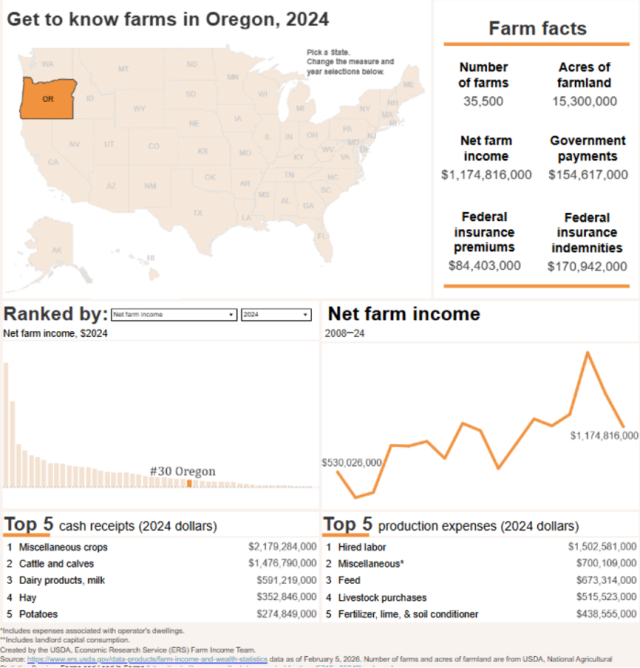
Oregon’s Second District is known for its diversified crops and the data shows these crops are being hit by a unique "scissors effect."
- The Input Gap: Unlike midwestern row crops, our district's specialty crops are incredibly input-intensive. ERS data shows that specialty crop producers are seeing their margins evaporate faster because their costs, specifically for specialized labor and irrigation power, are rising faster than the national average.
- The 2025 Price Drop: In a staggering display of market volatility, onion prices dropped 43% in 2025 alone. When you combine a 43% drop in what you get paid with a 30% increase in what you pay for fertilizer, you get a crisis.
|
|
|
Fertilizer
It’s no secret that the skyrocketing cost of fertilizer has been a "silent tax" on every acre in Oregon’s Second District. I have been clear with my colleagues in Washington: we cannot have food security without fertilizer security. The data from the USDA Economic Research Service (ERS) shows that while prices have dipped from their absolute peaks, they remain at a "new normal" that is 30% to 40% higher than just a few years ago.
To fight this, I have been engaged on two major fronts to restore our domestic supply and bring those costs back down to earth for our farmers.
1. Reopening the Meridian, Idaho Plant
- I am actively advocating for the reopening of the fertilizer production facility in Meridian, Idaho. For our producers in Eastern Oregon, having a regional supply chain isn't just a matter of convenience, it’s a matter of survival.
- When we rely on fertilizer shipped from halfway across the globe, our farmers pay the price for every spike in maritime fuel and every bottleneck at a foreign port. By bringing this plant back online, we can create a reliable, Pacific Northwest-based supply that cuts out the middleman and reduces the "transportation tax" that currently inflates every ton of fertilizer delivered to our co-ops.
|
|
|
Declaring Potash and Phosphate as "Critical Minerals"
On March 31, 2025, I joined my colleagues in signing a formal letter to the administration demanding that potash and phosphate be officially designated as Critical Minerals. The Administration agreed with my stance and on November 7,2025 both potash and phosphate were listed as critical minerals.
Currently, the U.S. is far too dependent on foreign adversaries for these essential nutrients. By designating them as critical minerals, we can now:
- Streamline Permitting: Cut through the federal red tape that currently prevents us from tapping into our own domestic reserves.
- Prioritize Domestic Production: Ensure that American soil is fed by American resources, insulating our growers from the whims of foreign trade manipulation.
- Drive Down Costs: Basic economics tells us that when we increase the supply here at home, the price for the end-user—our farmers—goes down.
|
|
|
The Bottom Line
We cannot be secure if we are dependent on others to feed our nation. Whether it is reopening regional plants like the one in Meridian or expanding the plant in Pocatello, or driving down, we must treat our fertilizer resources with strategic importance. |
|
|
Sincerely,
Cliff Bentz
Member of Congress
It is the honor of a lifetime to represent you in Congress. Should you need to contact me or my staff, please do not hesitate to do so. You can visit my website here.
Don't forget to follow me on Twitter, Facebook, Instagram, and YouTube!
|
|
|
|
| |
| Unsubscribe |
|