|
2026 Memorial Day Weekend
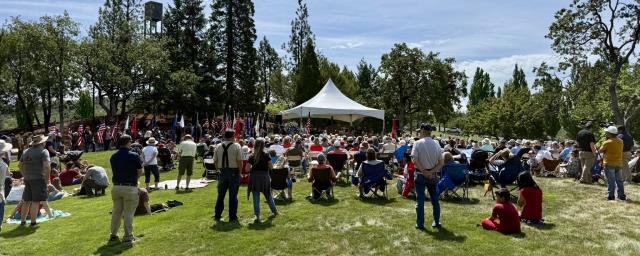
On Memorial Day, Monday, May 25th, 2026, hundreds of people gathered at Eagle Point National Cemetery to honor the men and women who died in military service. This annual commemoration featured military honors, a wreath-laying, the playing of the Taps, a WWII Stearman bi-plane flyover, music, and guest speakers. The cemetery serves as the final resting place for over 28,000 veterans, spouses, and their dependents.
During the ceremony, I spoke about the importance of taking time on Memorial Day to remember and actually think about what sacrifice is, what normal Americans have done for us, and our obligation to reach out to those who have suffered loss.
Here is my speech:
“Thank you for that most kind introduction. And thank you Senator Wyden for your kind remarks. I am glad to be joining all of you on this Memorial Day. It’s a special day and I am honored to be a part of it.
This morning, I want to recall our responsibility to remember those who have died, our duty to confront the depth of sacrifice of the dead and their families, and finally, the need to help their loved ones manage through.
Calling to mind death is difficult because our society doesn’t focus on it at all. One could say that we are a country in the permanent state of denial. Yet in life we don’t encounter many things more unavoidable. This Holiday is, in a sense, a societal aberration because it asks us to face death through remembrance and memory. Some may ask why dredge up thoughts of sadness and loss- what good does it do? The answer is quite simple- today is the ultimate reality check. The reality is that there is a cost to having a country, far greater than dollars, and that cost has been paid by ordinary Americans over and over again. To forget them is to abandon the belief that what we have in the form of this great 250 year experiment that we call America was worth dying for.
Remembering the Dead is essential but remembering the sacrifices of the families, brothers and sisters in arms, and friends of those who have died in service is equally important. Reaching out to them, sharing in their pain and extending our sympathy and compassion, as they deal with horrific loss is a part of holding this country together.
Justifying the loss of life in military conflict is sometimes difficult, but there is no doubt whatsoever that without our men’s and women’s willingness to give up their lives in this country, we would be a far, far different nation. In fact, without their sacrifice, one wonders if we would even have a nation. Their willingness to put their lives on the line is why we have stability, safety, and freedom. We need to remember that the existence of this nation didn’t and doesn’t just magically happen- these components of country and liberty were and are maintained at a terrible cost, the profound evidence of which is entombed in this very cemetery.
There are many contradictory concepts contained in our countries’ formative documents, one being that we send men and women into war to give up their lives for their country when in our country’s constitution we profess that life is the most important thing. The founding fathers called this out in the Declaration of Independence as the first prerequisite of liberty. The Declaration provides: “…Endowed by their creator with certain inalienable rights, among them Life, Liberty, and the pursuit of happiness”. This protection of life for all Americans is as basic as it gets. Yet members of our military forfeit their constitutionally protected right to live, life being the essence of freedom, to keep our country free. Such sacrifice is a truly amazing thing.
I think those who created Memorial Day wanted us to do what we are doing today, with flags and bunting and ceremony, but as I mentioned earlier, I think they also wanted us, for at least a few moments, to pause and to try to comprehend the reality of death that our military, and their families, must accept as a very real part of their service.
A personal story may help break through the barrier of denial that makes it almost impossible to realize death’s depth of deprivation.
In 2013, while a member of the Oregon House of Representatives, I was asked to carry a resolution designating a portion of Oregon route 34 as the Eric McKinley and Tyler Troyer Hero Memorial Highway. This bill was intended to be the foundation for Oregon’s fallen hero roadside markers.
I was asked to speak in support of the bill and I was prepared to talk about sacrifice and loss. But I was given a letter from Tyler’s mother Terrie Thorpe, to share about her son, Lance Corporal Tyler Troyer, and it was immediately apparent that her letter did a far better job than I could ever do in expressing the horrid, grinding, permanent reality of loss. You should know that Lance corporal Tyler was just 21 years old when he was killed serving in Iraq. He had just three months left on his tour when he was fatally struck by small arms fire while on foot patrol.
This is what Tyler’s mother wrote:
“To the world, is has been seven years since Tyler was killed in Iraq. People think that time heals all wounds or that pain fades away, but for a mother, there is no such thing as time when it comes to losing a child. The grief doesn’t have an expiration date.
Every day we carry the weight of his absence. When we look at his empty chair at the table, or think of the life he should be living, the pain is just as sharp as the day the officers knocked on my door.
This bill isn’t just about putting up a piece of metal on a highway. It is about memory. It’s about ensuring that when people drive down route 34, they are reminded that freedom isn’t an abstract concept—it was paid for by local boys like my son. It gives our family a place to look, a public acknowledgment that Oregon remembers Tyler, and that his sacrifice mattered.”
Of course Tyler’s bill passed the Oregon House and Oregon Senate unanimously.
Thank you, Terrie Thorpe, for sharing your thoughts with us. And thank you Tyler, for giving your life in service of our country.
It is my hope that today’s ceremony sharpens our understanding of the incredible sacrifice made by our military and their families, improves our ability to deal with such loss, and encourages participation in our democracy for which they have paid so dear a price.
Thank you for being here today, may God Bless each and every one of you, and may God Bless America.”
Thank you to all who joined me, veterans, families, and community members in remembering those who gave their lives in service to our nation. Memorial Day is not only a time to honor the fallen, but also an opportunity to reflect on the freedoms their sacrifice secured and the responsibility we share to preserve their legacy for future generations.

Later that day, I joined veterans, families, and community members in Medford for the dedication of a replica of the Vietnam Memorial Wall constructed at the Howard Memorial Sports Park. This impressive memorial is a 75% the size of the Vietnam Veterans Memorial in Washington, D.C. It bears the names of 58,479 Americans who lost their lives during or because of the Vietnam War. Their names are set forth on the wall in chronological order of death, just as set forth on the original Washinton D.C. monument.
For more than 15 years, the Southern Oregon Veterans Benefit worked to make this memorial a reality, raising over $300,000 through the support of local donors, veterans, and community partners. The completed wall stands as a lasting tribute to those who served and sacrificed, ensuring future generations understand the cost of the freedoms we enjoy today.
The Eagle Point National Cemetery event and the Vietnam Memorial Wall Dedication ceremony in Medford served as stark reminders that our country and the ideas that make it a beacon of freedom have a necessary but dreadful cost. The community members who worked to make both events happen so successfully deserve our heartfelt thanks. They gave us the opportunity to honor those who never came home, remember the families who carry their legacy forward, and recommit ourselves to the preservation of the nation so many gave their lives to defend.
Here are the remarks I shared at the Vietnam Wall dedication ceremony:
“Thank you for the opportunity to speak on this important occasion. There is much to be said and much has been said about the Vietnam war. But for our purposes today, I will focus on the reprehensible failure of our society to support the men and women, the average age of which was around 22, when they returned from a war they had no part in starting and some no choice in fighting.
Before I talk about this wall, let me mention my history of involvement in the Vietnam war.
I turned 18 in 1970. I was not placed into the draft lottery until August 5th, 1971. My number was 228. In that year, the service called up only those who had numbers up to 95. Thus I was not called upon to serve. The lottery was held in at the Selective Service System headquarters in Washington D. C.
I remember that Thursday, August 5th date, at about 8:00 in the morning, standing in the kitchen by the radio, on my families’ ranch, listening to KBOI broadcasting from of Boise Idaho -about 120 miles away-(we didn’t have television in our remote part of Harney County) as the numbers, 1 through 366, and the birthdays (every calendar day including February 29th) were placed in and then drawn from two large rotating drums. They were then matched and called out. My birthday was January 12th. You can guess my relief when January 12th was paired with the number 228. What was a bit surprising was that I was the only one of my family listening as these numbers were drawn. To our family, service was something accepted and not to be avoided, so had my number been called, I would have joined up.
Those who did serve, doing that which their country asked of them, such as my good friend and former colleague in the Oregon House Sal Esquival, were returned after their tour to a country divided and angry. Soldiers like Sal, were cursed at and spit upon. They were called baby killers. They were blamed for a policy of war that they had no part in creating. They were the target of anti-war activists who chose, for political gain, to harness the nation’s anger and frustration with the war and direct it at those least responsible for it. 20 year olds sent to carry out political policy. This treatment of our soldiers was inexcusable and abhorrent. And worse, it continued in some respects, for at least 20 years. Veterans themselves took up the cause of reminding the nation that it was the warrior, not the war, that should be, that must be, honored. The building of the Vietnam wall and its dedication in 1982 forced the American public to recognize that the soldier who carried out orders was not the architect of the political policy that lead to the war.
The Washington D.C. wall, although late in coming, was the first formal recognition of the valor, bravery, and willingness to support country exhibited by those whose names appear before us today.
Those in this community who stepped up to pay for and to build this Medford, Oregon, version of the Vietnam Wall deserve our deepest appreciation, gratitude, and respect. Not just because of the value this wall has for those who served in Vietnam, but also for the part this wall will play informing young people, as they study it, as they drive by it, as it is mentioned in the press and on line, of the true and awful cost of war, the cost of serving one’s country, and the reality of that cost- the loss of 58,281 lives. War is a terrible but necessary thing. We must not forget those that had the courage to fight our wars for us. This wall shows that this community believes in its veterans, understands their value, and the permanency of their sacrifice for our country. I want to say thank you again, both to the veterans here today and to those who made the construction of this Vietnam Wall here Medford, Oregon, for what you have done. And to all you who served in Vietnam, and elsewhere for this country, Welcome Home. And may God Bless each of you, all who have given their lives for us, and this great country of America.
Thank you to all who joined me, veterans, families, and community members in remembering those who gave their lives in service to our nation. Memorial Day is not only a time to honor the fallen, but also an opportunity to reflect on the freedoms their sacrifice secured and the responsibility we share to preserve their legacy for future generations." |