|
FIRE
2026 will be remembered as one of the worst fire years in Eastern Oregon’s history. Drought, wind, and lack of proper range and forest management have combined to make our homes and ranches and farms and towns parts of a tinderbox of massive proportion. An evening of lightning has now sparked fires in too many places to count. Our prayers are with our firefighters and the people, livestock, land, and businesses put at risk of harm and destruction.
My team in Washington and Oregon and I have been responding to dozens of calls regarding priorities in fighting the fires, and on programs available to those damaged by the fires. Attached is a summary of some of the programs that have been created to help after the fires have worked their destruction.
My job as a congressman, as I see it, is to have the people who work in my offices respond to your questions regarding prioritization of fire response, to help direct people affected by the fire to the resources available to rebuild, and to help design and pass laws that help reduce the incidence and severity of these fires. Several of the laws that we have been working on to help reduce fire severity are set forth in this letter.
Introducing the “Wildfire Reduction Market Expansion Act of 2026”
On Wednesday, July 22nd, I introduced (“dropped”) the “Wildfire Reduction Market Expansion Act of 2026” with Congressman Bennie Thompson (D-MS), joining Senators Merkley (D-OR) and Hyde-Smith (R-MS), who simultaneously introduced an identical bill in the U.S. Senate.
This is an incredibly important bill. If passed and signed into law, it would provide funding for forest thinning and the removal of excess wood and brush from overgrown areas of the woods. The explosion, right now, of dozens of wildfires across Oregon shows just how incredibly dangerous and damaging forest conditions have become. It’s difficult to explain to those unfamiliar with the Western part of the United States the immense scope, size, and danger of our overgrown forests. It’s up to me and my western colleagues to explain to our eastern friends that hundreds of thousands of tons of new wood grow in Oregon’s forests each and every day, vastly increasing the chance and the danger of cataclysmic wildfire. We must convince them that this danger can and must be reduced by removing brush and excess trees from our forests. Technology has found a way to convert wood into biofuel, so this wood does have value. The challenge, resolved by this bill, is to properly focus existing financial support systems on the removal, transport, and processing of qualified wood from our forests to biomass processing facilities. This bill would provide financial support for such removal by making clear that the Renewable Fuel Standard is available support removal of woody biomass from federal forest land. Removal of this biomass will reduce costs of fire suppression, protect forest health, and improve and preserve watersheds.
You can find an in-depth press release on the introduction of the bill HERE.
The Federal Emergency Management Agency Partially Approves Oregon’s Requests for Fire Aid, Declaring Possible ‘Major Disaster’
The Federal Emergency Management Agency (FEMA) approved three of five Oregon requests for Fire Management Assistance Grants (FMAG). These grants are meant to provide financial assistance to state, local, tribal and territorial governments to help mitigate, manage and control active wildfires on public or private forests or grasslands that threaten to become major. Three of the governor’s applications for such designation were approved, the Lower Dry Creek Fire near Milton-Freewater, the Awaka Butte Fire near Sisters, and the Grasshopper fire near Pine Hollow.
According to FEMA’s office of external affairs, these fires, at time of designation, could have become “major disasters” without speedy intervention. It appears, sadly, that these have indeed become major fires.
Lower Dry Creek Fire
FEMA approved, on July 16th, the State of Oregon’s request for FMAG assistance for the Lower Dry Creek Fire burning in Umatilla County. Oregon requested FEMA assistance on July 15, the same day the fire started.
Between the time the fire began and the time of the request, the Lower Dry Creek Fire had already burned 5000 acres of federal, state, private, and tribal land, threatening 428 homes in addition to outbuildings, schools, fire stations, commercial buildings, radio and cell towers, natural gas and electrical utilities, and agricultural operations in the communities of Milton Freewater, Athena, Weston, Adams, and Tolgate.
Additionally, when Oregon made the request, the fire was 0 percent contained. FEMA determined that the Lower Dry Creek Fire threatened destruction that would constitute a major disaster without FEMA’s assistance and approved the state’s request.
Awaka Butte Fire
Oregon submitted another FMAG request on July 22 for the Akawa Butte Fire burning in Jefferson and Deschutes Counties. By the time of the request, the fire had burned nearly 14,000 acres of federal, state, and private land.
FEMA determined that if the fire continued without containment, it would constitute a major disaster, threatening nearly 700 primary homes, five fire stations, cellular towers, power lines, and power transmitters. FEMA approved Oregon’s request on July 23.
Grasshopper Fire
FEMA approved an FMAG request for the Grasshopper Fire affecting Wasco County on July 25, the same day Oregon made the request. Between the time the fire began on July 23 and the FMAG request, the fire burned 3,500 acres of federal land, was 0 percent contained, and threatened nearly 700 homes. The fire also threatened commercial and residential buildings, electric utilities, campgrounds and trails, BLM roads, and radio and cellular facilities around the communities of Tygh Valley, Wamic, Pine Hollow, and Sportsman’s Park.
FEMA determined that the Grasshopper Fire has the potential to become a major disaster and swiftly approved the request.
Once a fire threatens to become a major disaster, FEMA’s FMAG grants funds up to 75 percent of a state’s eligible firefighting costs. These costs can include expenses for materials, equipment use, and mobilization activities that support firefighting efforts.
With FEMA’s assistance, we are responding quickly to contain and control these fires. I will continue to work closely with FEMA and administration agencies as they support efforts to fight fires across Oregon.
The Fix Our Forest Act:
Here is a brief summary of the “Fix our Forest Act”. This bill was passed by the House. It had not been taken up by the Senate. We will be working, with the Chair of Natural Resources, Bruce Westerman, to try to get the Senate to move this important bill.
The Fix Our Forests Act is a historic and comprehensive package that will encourage active forest management and support community resiliency to wildfires by expediting environmental analyses, reducing frivolous lawsuits and increasing the pace and scale of forest restoration projects.
The bill will:
- Simplify and expedite environmental reviews for forest management projects.
- Make communities more resilient to wildfires by better coordinating existing grant programs and promoting new research.
- Promote federal, state, tribal and local collaboration.
- Deter frivolous litigation that delays essential projects.
- Create a framework for prioritizing treatments in the forests at the highest risk of wildfire and near vulnerable communities.
- Encourage the adoption of state-of-the-art science and techniques for federal land managers.
- Encourage active management to improve the safety of powerlines and other infrastructure.
- Strengthen tools like Good Neighbor Authority and Stewardship Contracting.
- Support wildland firefighters and their families by ensuring continuity in casualty assistance programs.
The House Passed Two Public Health Bills I Co-Sponsored
On July 20, the House passed twelve public health bills. I co-sponsored both H.R. 5160, the Stem Cell Therapeutic and Research Reauthorization Act of 2025, and H.R. 4348, To Reauthorize the Kay Hagan Tick Act, and for Other Purposes.
The Stem Cell Therapeutic and Research Reauthorization Act of 2025 would reauthorize two innovative programs, the National Cord Blood Inventory and the National Marrow Donor Program, allowing them to provide treatments that can save hundreds of thousands of lives.
Congressman Chris Smith’s (R-NJ) bill would allow stem cells from medical waste to contribute to these programs.
H.R. 4348 would reauthorize federal efforts to fight vector-borne diseases such as Lyme disease. Research funding for these diseases expired in 2025. Smith’s bill would reauthorize this funding until 2030, providing valuable resources to hospitals to treat people with vector-borne diseases.
USDA Breakfast
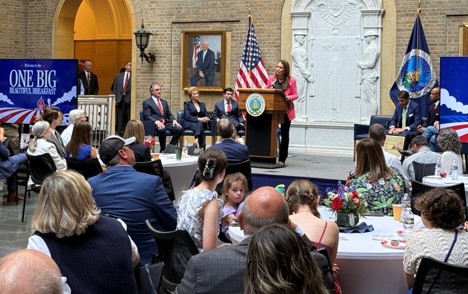
Secretary of Agriculture Brooke Rollins speaks at the USDA’s celebratory breakfast!
On Friday, July 3, I joined Secretary of Agriculture Brooke Rollins, Secretary of Interior Doug Burgum, and many other cabinet officials for a breakfast intended to kick off the U.S. State Fair. The breakfast was held at the USDA office here in D.C. The breakfast celebrated 250 years of agriculture excellence in the United States, and featured speeches from each of the cabinet members who attended. An interesting morning. |