|
Dear Friend,
As Chairman of the Financial Services Subcommittee on Oversight and Investigations, I’m helping lead the fight against rampant scams and fraud targeting Pennsylvanians and all Americans.
We’re working with the private sector, the White House, law enforcement, as well as through congressional investigations to expose and prevent scams.
Protecting our nation's veterans has always been one of my top priorities in Congress. Unfortunately, bad actors continue to target those who served our nation with increasingly sophisticated scams designed to steal personal information and benefits, while jeopardizing a person's financial security.
Read below to see how a new scam circulating in Pennsylvania is targeting veterans, and other scams to look out for.
New Scam Targeting Pennsylvania Veterans:
Veterans across the Commonwealth have received a direct-mail postcard advertising something called the “PA Veteran Savings Program 2025.” The mailing claims that eligible veterans can receive an additional $160 per month and references legitimate programs like CHAMPVA and TRICARE for Life. It looks official, but it’s NOT real.
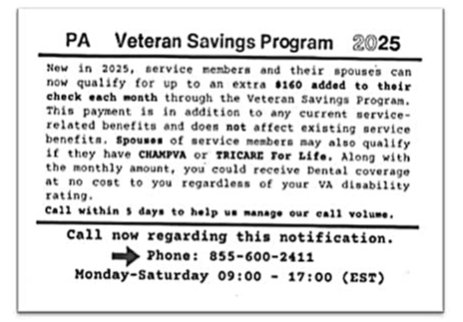
The postcard urges recipients to call within five days to “help manage call volume” — a classic pressure tactic intended to push veterans into responding quickly. It is entirely fraudulent:
- It lists no return address.
- It uses a bogus phone number: 855-600-2411.
- It falsely implies support from state and federal veterans programs.
Scammers know that many veterans rely on monthly benefits and may be drawn to the promise of additional support. That’s why these schemes are so dangerous — and why awareness is critical.
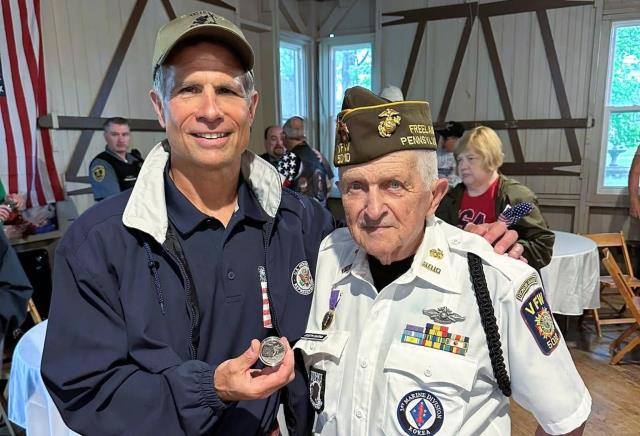
How Veterans Can Protect Themselves
If you get this postcard, don’t call. Verify any claims directly with the PA Department of Military and Veterans Affairs at 800-547-2838.
Do not respond directly.
Accredited Veteran Service Officers: with the VA or a part of a Veteran Service Orginization like the VFW or the American Legion — available at no cost — can:
- Verify whether a program is legitimate
- Help you secure and protect your earned benefits
- Report fraudulent activity
- Provide guidance tailored to your situation
Other Common Scams to Look Out for:
Relationship Investment Scams (Romance Scams) This can start with a simple text or DM. Scammers try to form a friendship with you — before offering a phony investment opportunity. Once the bait is taken, they vanish, along with your money. Ignore messages from anyone you don’t know and consider deleting or blocking them.
Imposter & Government-Agency Scams
Scammers pose as the IRS, Social Security, a bank, tech support, or even a relative (“grandparent scam”) to demand money or personal info urgently. Hang up; verify using official phone numbers/websites; never pay by gift card.
Phishing/Smishing/Vishing
Fake emails, texts, or calls try to make you click links, download malware, or reveal credentials or codes. Don’t click; type the site yourself; use multi-factor authentication; use a password manager. Report tax-themed phishing to the IRS.
Card, ACH & Check Fraud
Lost/stolen card numbers, counterfeit checks, “washed” checks from mailboxes, or unauthorized ACH. Use secure mail (or the post office); lock your mailbox, monitor accounts, set alerts, and report immediately.
Financial Exploitation
Unauthorized withdrawals, pressure to buy gift cards, “tech support” refunds, romance/inheritance scams. Talk to a trusted family member or banker; call the Elder Fraud Hotline.
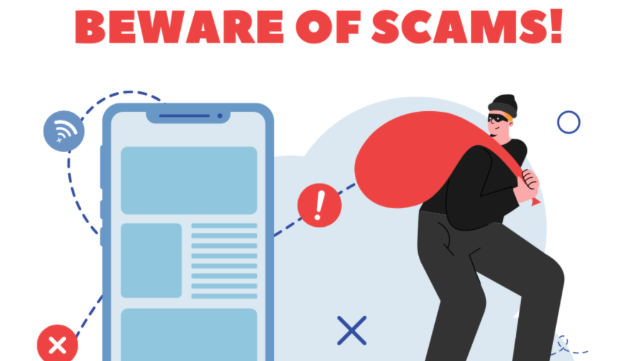
If You’ve Been Scammed or Suspect Fraud - Do this first:
- Contact your bank/credit union/card issuer immediately to freeze accounts, dispute charges, and initiate recalls (for wires/ACH). For business-email compromise (BEC), ask your bank to contact the destination bank and move fast on a recall. Then file with the FBI Internet Crime Complaint Center (IC3)
- Report it so law enforcement can act. FTC’s ReportFraud.ftc.gov routes cases to the right agencies.
- Protect your identity (Place a fraud alert/credit freeze, create an IdentityTheft.gov recovery plan).
- For older victims or caregivers, call DOJ’s National Elder Fraud Hotline: 833-FRAUD-11 (833-372-8311) for one-on-one help.
For more help, visit my office’s anti-fraud resource page: Meuser.House.Gov/Scams. Here, you’ll find tips on spotting scams, steps to take if you’ve been targeted, and links to report suspicious activity.
Stay Vigilant and Spread the Word!
These scammers are clever! The best defense is awareness. Please share this information with other veterans, families, caregivers, and community organizations. No veteran should fall victim to predatory schemes targeting their hard-earned benefits.
As always, your input is essential to helping me serve you in Washington. Please share your thoughts with me through my website, Meuser.House.Gov, or by calling my Washington, DC office at (202) 225-6511, or my Pottsville office at (570) 871-6370.
For more content regarding my activity in Washington and in our district, please follow me on Twitter, Facebook, Instagram, Truth Social, and YouTube.
Sincerely,
Dan
|